The Chariot Tarot Card Meaning: Willpower, Direction, and Winning the Hard Way
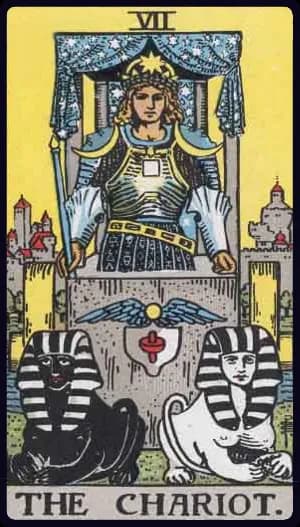
The Chariot is card seven, and it's the first card in the Major Arcana that's about winning. The cards before it are about learning who you are, who taught you, and who you choose to love. The Chariot is what happens when you take all of that and point it at something. A figure in armor stands in a vehicle that's going somewhere, and the only question is whether they can keep it on the road.
It's a card people tend to like getting. It feels like momentum, and usually it is. But the Chariot is also one of the more misunderstood cards in the deck, because the victory it shows isn't easy or automatic. Look closely and you'll notice there are no reins. Whatever is pulling this chariot forward is being held together by willpower alone.
This guide covers where the card came from, what every detail on the Rider-Waite-Smith version means, the astrology behind it, how to read it upright and reversed in every area of life, how spread position changes it, which cards change its meaning, and the mistakes people make when it shows up.
Quick reference
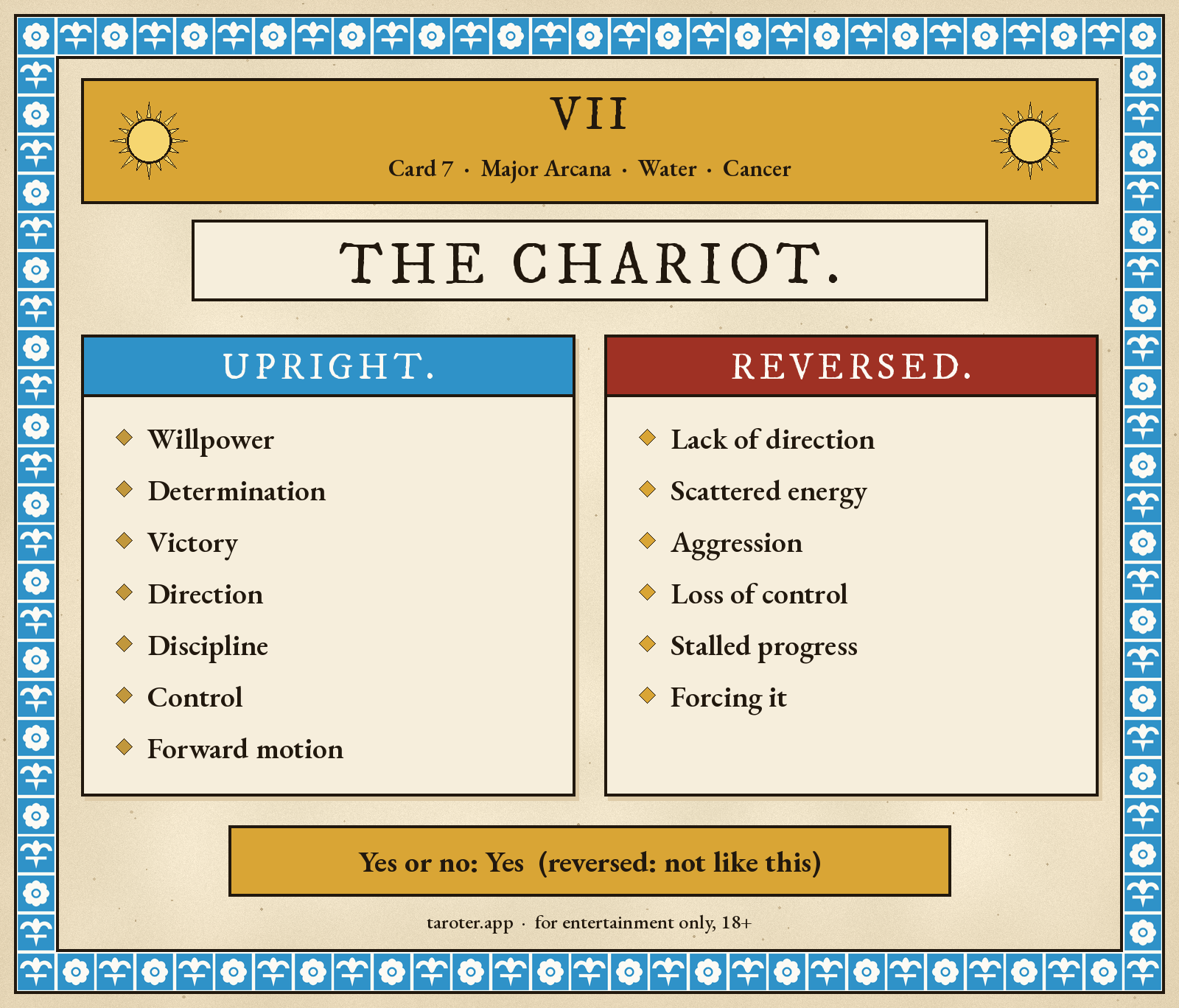
| Number | 7 (VII) |
| Arcana | Major |
| Element | Water |
| Astrology | Cancer |
| Hebrew letter | Cheth (ח) |
| Upright keywords | willpower, determination, victory, direction, discipline, control, forward motion |
| Reversed keywords | lack of direction, scattered energy, aggression, loss of control, stalled progress, forcing it |
| Yes or no | Yes (reversed: not like this) |
Where the Chariot comes from
Tarot began in 15th-century Italy as a card game, and the picture cards that became the Major Arcana were called trionfi, "triumphs." That's where the English word "trump" comes from. The name probably comes from the triumphal processions of Renaissance Italy, which were popular in art and poetry at the time: parades where a figure rode a decorated cart, followed by another figure who outranked them, and so on. In that world, a chariot was the natural picture of triumph. It was literally the vehicle of a victory parade.
In some of the earliest surviving Italian decks, the Chariot shows a richly dressed woman riding in a cart pulled by white horses. She reads as an allegory: Fame, or Love, or some other virtue being paraded through the streets. Over time the rider became a crowned man in armor, and by the Tarot de Marseille he's a king or prince standing in a square chariot pulled by two horses. In many Marseille decks, the horses look like they're pulling in slightly different directions, which is a detail worth keeping in mind. He also wears shoulder pieces shaped like faces, a detail that survives into the modern card.
In the 19th century, the French occultist Éliphas Lévi redesigned the Chariot in his writings and swapped the horses for two sphinxes, one black and one white. That change stuck. When Arthur Edward Waite and Pamela Colman Smith created the Rider-Waite-Smith deck in 1909, they kept Lévi's sphinxes and built the rest of the card around them.
Waite's Pictorial Key to the Tarot (1910) describes the charioteer as a princely, victorious figure who has conquered on every level, but he's careful to say the conquest happens first in the charioteer's own mind and will. That's an important distinction. Before the Chariot can beat anyone else, it has to get its own driver under control well enough to move. His divinatory meanings for the upright card include help, providence, triumph, and also war, trouble, and presumption. For reversed he lists riot, quarrels, disputes, and defeat. So even Waite saw both sides: the Chariot can win, and it can also pick a fight it shouldn't.
Modern readers have mostly settled on the version you'll find in this guide: determination, direction, discipline, and victory earned through focus.
Where this card sits in the Fool's Journey
In the last card, the Lovers, the Fool faced a real choice for the first time. After the Hierophant's lessons, this was a decision that came from their own values. The Lovers asks: what do you actually want, and what are you willing to commit to?
The Chariot is the answer in motion. Having made a choice, the Fool now has to act on it. This is the first time on the journey that the Fool goes out into the world and tries to accomplish something by force of will. The early cards built the Fool up from the inside: skill, intuition, nurture, structure, belief, love. The Chariot is the graduation test. Can you take everything you've learned and use it to get somewhere?
The catch is that the Chariot's kind of power is external and effortful. It's the power of gritted teeth and white knuckles. It works, but it's tiring, and whatever is pulling you in two directions stays there, held in check. That's why the next card, Strength, matters so much. Strength takes the same problem (two forces that need to be mastered) and solves it in a completely different way: with gentleness. The Chariot wins the battle. Strength makes peace with the thing you were fighting.
The symbolism, detail by detail
Smith's Chariot is crowded with symbols. Here's what's actually on the card.
The charioteer. A young man in armor stands upright in the chariot, calm and steady, looking straight out at you. He doesn't look strained. His composure is part of the message: his control comes from inside.
No reins. This is the detail most people miss. There's nothing connecting the charioteer to the sphinxes. He's steering by will alone. Some readers say that means the control is mental and spiritual. Others say it means the whole setup could fall apart the moment he loses focus. Both readings are useful.
The wand in his hand. He holds a short wand or scepter in his right hand, a symbol of will and authority. It links back to the Magician's wand: the same power of directed intention, now being used to drive something forward. (Waite's text actually mentions a drawn sword, but Smith painted a wand.)
The two sphinxes. One black and one white, sitting in front of the chariot. They stand for opposing forces: light and dark, positive and negative, instinct and reason, any two things inside you that want different things. They aren't pulling in sync. In fact they seem to be looking off in different directions. The charioteer's job is to make them move together anyway.
The starry canopy. Above his head is a blue canopy covered in stars, held up by four posts. It suggests he's protected by, or connected to, something heavenly. His will is aligned with something bigger than ego.
The crown and star. He wears a crown topped with a star. That's victory and enlightenment together: he rules himself, and he's guided by a higher aim.
The crescent moons on his shoulders. His shoulder pieces are crescent moons with faces on them. These connect to the card's astrology (Cancer is ruled by the Moon) and to the emotional, changeable inner life he's keeping in check. Waite also says the shoulder pieces represent the Urim and Thummim, sacred objects worn by the high priest of ancient Israel that were used to receive divine answers.
The square on his chest. A square sits on his breastplate. Squares in tarot usually mean the material world, earth, and the four elements. It suggests his strength is grounded and solid.
The symbols on his belt and skirt. His belt and skirt are decorated with astrological and magical symbols. They suggest the charioteer has cosmic forces working with him on top of his own effort.
The shield on the front of the chariot. A red shield on the front bears a symbol usually identified as the Hindu lingam and yoni, the union of masculine and feminine. Above it is a winged disk, an ancient Egyptian symbol of the sun and divine protection. Together they suggest the joining of opposites and the inspiration that drives the whole machine.
The stone chariot. Look at the chariot itself. It looks like a solid block of stone with wheels on the sides. It doesn't look like it could move very fast, or at all. Some readers take that as a hint that the Chariot's real movement is internal, a matter of will.
The city behind him. In the background is a walled city with towers, a river, and trees. He has left the comfort and safety of home and is heading out. The river can be read as the flow of emotion and life he's moving away from, or across. Either way, he has put the city behind him.
Astrology, element, and the Hebrew letter
In the system the Golden Dawn built, which Waite followed, the Chariot is linked to the zodiac sign Cancer, the Hebrew letter Cheth (ח), and so to the element of Water.
Cancer is a surprising match at first. You might expect a card about victory and armor to belong to Aries or Mars. But think about the crab: hard shell on the outside, soft on the inside. That's the charioteer. The armor is real, but it's protecting a sensitive, emotional center. Cancer is also a cardinal sign, which in astrology means a sign that starts things and drives action. And Cancer is ruled by the Moon, which explains the crescent moons on his shoulders.
The Water element fits the same way. Underneath all the determination is feeling. The Chariot often shows up when someone is pushing hard toward a goal because of something emotional: wanting to protect their family, prove themselves, or get away from something that hurt them.
Cheth means "fence" or "enclosure." That's a good image for the card. A fence protects what's inside, and it marks a boundary. The charioteer's armor and chariot are a kind of fence too, holding his energy together and keeping the world out. The Golden Dawn's title for the card was "Child of the Powers of the Waters, Lord of the Triumph of Light," which sums it up nicely: born of emotion, victorious through light.
If you're a Cancer or have strong Cancer placements in your chart, the Chariot may feel familiar: the soft heart, the hard shell, and the determination to keep the people you love safe.
The Chariot upright
Keywords: willpower, determination, victory, focus, direction, self-discipline, ambition, control, momentum.
When the Chariot shows up upright, you've got the drive to get where you're going. Something is moving forward, and it's moving because you're pushing it. This is the card of the deadline met, the exam passed, the training plan finished, the move pulled off against the odds.
The upright Chariot is about focus. It's very good at one thing at a time. If you've been spreading yourself across five goals, it says pick one and commit to it. The charioteer doesn't wander. He has a direction and he holds it.
It's also about discipline. The sphinxes are pulling different ways. Most of us have the same problem: part of you wants to work on the thing, and part of you wants to scroll your phone. Part of you wants to be healthy, and part of you wants the cake. The Chariot doesn't pretend that conflict isn't there. It says you can be the one in charge of it.
And the upright Chariot is about confidence. The steady, quiet kind. The charioteer stands still in the middle of all that motion. If you've been doubting whether you can do something, this card is about as clear a "you can" as tarot gets. The victory is likely, as long as you keep your hands, so to speak, on the reins that aren't there.
One more thing: the Chariot is literally a vehicle, so it often shows up around travel, especially road trips, moving house, or a journey where you're in charge of getting there.
The Chariot reversed
Keywords: lack of direction, scattered energy, loss of control, aggression, stubbornness, stalled progress, forcing outcomes, self-doubt.
Reversed, the Chariot is a vehicle that isn't working right. That can go two very different ways.
The chariot that won't move
The sphinxes have wandered off in different directions and you've stopped trying to bring them back. You've lost your sense of direction, or your motivation, or your belief that you can actually get there. Progress has stalled. You might be starting and stopping, switching goals every few weeks, or just feeling like you're going in circles.
This version often comes with self-doubt. You used to know where you were going, and now you're not sure it's worth the effort. Or you're so divided about what you want that you can't commit to anything.
The chariot driven too hard
The opposite problem. You're so determined to win that you've started running people over. This is the aggressive, controlling side of the card: bulldozing through objections, refusing to compromise, treating every disagreement as a battle. It's the version Waite was pointing at when he listed quarrels and disputes. It can also look like trying to force an outcome that just isn't going to happen, no matter how hard you push.
This version is sneaky, because from the inside it feels like determination. From the outside it looks like stubbornness.
How to tell which one it is
Ask yourself one question: am I not pushing enough, or am I pushing too hard? Look at the surrounding cards too. Cards like the Four of Cups or the Eight of Swords next to it suggest the stalled version. Cards like the Five of Wands, the King of Swords reversed, or the Tower point to the aggressive one.
Either way, the fix is the same: get back in the driver's seat, but with a lighter grip. Figure out where you actually want to go, and stop wasting energy fighting yourself or other people.
The Chariot in love and relationships
Upright
If you're single: you know what you want and you're going after it. That's attractive. The Chariot can show someone who decides to go after dating with real effort. It can also mean meeting someone while traveling or during a busy, ambitious time in your life. Just be careful not to treat love like a project to win.
If you're in a relationship: you're working through challenges together and coming out ahead. The Chariot often shows a couple pulling together toward a shared goal: buying a house, moving cities, getting through a hard year. It can also show two very different people who make it work because both of them are committed. The two sphinxes, different but moving together, are a pretty good picture of a lasting relationship.
For feelings ("how do they feel about me?"): they're determined and serious about you. They want to make it work and they're willing to put in the effort. They might be a bit guarded emotionally (remember the crab shell), but their intentions are strong.
Reversed
If you're single: you may be chasing someone who isn't interested, or trying too hard to control how dating goes. Or the opposite: you've lost interest in looking at all, and you're not sure what you even want.
If you're in a relationship: a power struggle. One or both of you is trying to steer, and you're pulling in different directions. It can also mean the relationship has lost momentum and is drifting without a shared goal. Watch for control issues on either side.
For feelings: they may be conflicted, pulled between wanting you and wanting something else. Or they want to be in control of the relationship more than they want to be in it.
The Chariot in career and work
Upright
This is one of the best career cards you can draw. It points to ambition, hard work paying off, and success through focus. Promotions, wins, finishing a major project, beating the competition for a job, launching something and making it work. It's especially good for anyone who has to push through obstacles: entrepreneurs, students in a tough program, people working toward a big qualification.
If you're asking whether you can pull something off, the Chariot says yes, if you stay focused. Pick the goal, cut the distractions, and keep going.
Reversed
A career that's stalled, or ambition with no clear direction. You might feel like you're working hard and getting nowhere, or switching paths so often that you never build momentum. It can also point to conflict at work: competition that's turned nasty, a boss who's controlling, or you being too aggressive with colleagues. Step back and figure out what you're actually trying to achieve before you push harder.
The Chariot in money and finances
Upright
Financial progress through discipline. Sticking to a budget, paying off debt, saving toward a big goal. The Chariot is about steady control: you're in charge of your money. It's a good card for making a planned financial move, like buying a car (very on-brand) or investing in yourself.
Reversed
Money is slipping out of your control. Impulse spending, a budget you can't stick to, or financial goals pulling against each other. It can also warn against forcing a financial decision out of pride or stubbornness. If you're pushing hard on a deal that keeps going wrong, it might be a sign to stop.
The Chariot in health and wellbeing
Tarot isn't a substitute for medical advice. If you have health concerns, see a professional.
Upright
Determination applied to your health. Starting a training program and sticking to it, recovering through effort, finding the discipline you need to change a habit. The Chariot is a good card for physical goals: running a race, building strength, getting back on your feet after an injury.
Reversed
Pushing your body too hard, or the opposite, losing motivation to look after it. Burnout is a real risk with this card, since the charioteer's kind of willpower uses up a lot of energy. It can also point to stress showing up physically because you're trying to control too much.
The Chariot in spirituality
Spiritually, the Chariot is about self-mastery. It's the discipline of a practice: showing up to meditate even when you don't feel like it, keeping your attention on the path. The two sphinxes are the two sides of your nature, and spiritual growth here means bringing them into alignment.
Reversed, it can mean you're trying to force spiritual progress, treating enlightenment like a goal to conquer. Or your practice has lost direction and you're drifting from one thing to another without any real commitment.
The Chariot by spread position
Where the Chariot lands in a spread changes what it's saying.
Past: a time when you fought hard for something and won, or a period of intense focus that shaped where you are now. It might also point to a past move or journey.
Present: you're in the middle of a push. Things are moving because you're making them move. Keep your focus.
Future: a nudge to think about where you want to take charge and drive things forward next.
Advice: take control. Decide where you're going and commit to it. Stop letting conflicting impulses steer you.
Obstacle or challenge: you might be too controlling or too stubborn, or you're divided against yourself and that's what's slowing you down.
Outcome: a reflection on what success through effort would look like here, and how much discipline you're willing to bring.
Hopes and fears: you might want success badly but fear what it'll cost, or fear losing control of a situation that matters to you.
The Chariot as a yes or no
The Chariot is a yes, and a confident one. It's especially strong for questions about achieving goals, winning, passing, or getting through something difficult. The yes comes with a condition: you'll need to stay focused and do the work.
Reversed, it's closer to not like this. The answer could still be yes, but the way you're going about it isn't working. Either you need more direction, or you need to stop forcing it.
The Chariot in combination with other cards
The cards around the Chariot shape how you read it. Some common pairings:
The Chariot + The Lovers: a choice followed by action. You've decided what you want, and now you're going after it. In love, it can mean committing to a relationship and working to build it.
The Chariot + Strength: two kinds of power together: outer control and inner calm. You've got the willpower and the patience. One of the strongest combinations for getting through a hard situation.
The Chariot + The Emperor: structured, disciplined success. Leadership, authority, and a clear plan. Great for career questions, though watch for rigidity.
The Chariot + The Tower: a sudden obstacle, or a crash. Momentum gets interrupted, or forcing things too hard leads to a collapse.
The Chariot + The Hermit: pulling back from the race. You might need to stop pushing and reflect on whether you're heading in the right direction.
The Chariot + Six of Wands: a public victory. Recognition, praise, and success that other people notice. This is the victory parade the Chariot was originally named for.
The Chariot + Two of Pentacles: juggling competing demands. You're trying to keep moving while balancing too many things. It can work, but it's fragile.
The Chariot + Seven of Wands: fighting to hold your ground. Determination under pressure, defending your position against opposition.
The Chariot + Eight of Wands: fast progress. Things are moving quickly, maybe travel, maybe a project picking up speed.
The Chariot + Four of Cups: lost motivation. You've got the vehicle but no reason to drive it. Time to reconnect with what you actually want.
Common mistakes when reading the Chariot
Reading it as easy success. The Chariot is victory through effort. It says you can earn the win with work.
Making it all about beating other people. The real battle on this card is internal. The sphinxes are your own competing impulses. Sometimes the Chariot shows up in a competition, but more often it's about getting yourself under control.
Missing the missing reins. The control here is mental. If you read the card as "push harder," you might miss that it's really saying "focus better."
Ignoring the emotional side. Because of the armor, people forget the Chariot is a Water card linked to Cancer. There's usually something emotional driving the push. Ask what it is.
Forgetting it can be literal. Sometimes a chariot is just a car. The card regularly shows up around travel, driving, vehicles, and moving.
The Chariot as a person
When the Chariot represents someone, it's usually a driven, ambitious, confident person who knows what they want and goes after it. They're competitive, disciplined, and good under pressure. They might be an athlete, a founder, a soldier, or that friend who trains for a marathon in four months and actually runs it. On the downside, they can be controlling, stubborn, or emotionally guarded, keeping their soft side behind a lot of armor. They're great to have on your side and exhausting to argue with.
Journal prompts for the Chariot
- What do I want badly enough to commit to fully?
- What are my two "sphinxes," the parts of me pulling in different directions?
- Where am I trying to control something that can't be controlled?
- What's the emotional reason behind the goal I'm chasing?
- What distractions do I need to cut to move forward?
- When have I won something through sheer determination? What did that feel like, and what did it cost?
Frequently asked questions
Is the Chariot a good or bad card? Mostly good. It's about willpower, direction, and victory. Reversed, it can warn about losing direction or being too aggressive, but it's usually pointing you toward a fixable problem.
What does the Chariot mean as feelings? Determination and commitment. The person is serious and wants to make things work. Reversed, they may feel conflicted or want more control than is healthy.
What zodiac sign is the Chariot? Cancer. That surprises people, but the crab's hard shell and soft center are a perfect match for the armored charioteer protecting something sensitive inside.
Does the Chariot mean travel? Often, yes. It can point to a trip, a move, or anything involving vehicles. It's especially linked to journeys where you're in control.
Why does the Chariot have sphinxes for horses? The sphinxes come from the 19th-century occultist Éliphas Lévi, who replaced the traditional horses. Waite and Smith kept them. They represent opposing forces, light and dark, that the charioteer has to keep moving together.
What does it mean if the Chariot keeps showing up? You're in a period where effort and focus matter. Something is asking you to take charge. If it keeps showing up reversed, look at where you've lost direction or where you're pushing too hard.
Where the journey goes next
The Chariot wins by holding everything together through sheer will. But willpower runs out, and the Fool is about to learn a different way to handle the wild forces inside. Next comes Strength, card eight: a woman calmly closing the jaws of a lion, with no armor and no weapon at all. That's tomorrow's card.
If you missed the step that led here, read the guide to the Lovers, where the Fool makes the choice the Chariot puts into motion. You can also see the Chariot's upright and reversed meanings and how it shows up in readings on the Chariot card page. Or draw a card in Taroter and see whether the Chariot is ready to roll for you.
Taroter
Author
Related articles
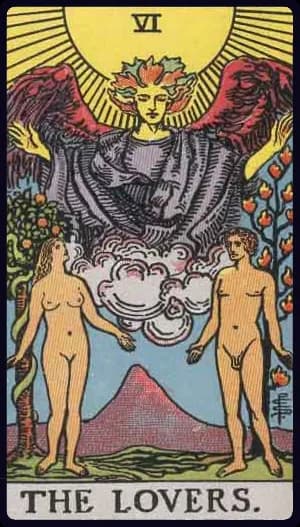
The Lovers Tarot Card Meaning: Love, Choice, and Living by Your Values
The Lovers is card six, and it's probably the card people most want to see in a love reading. Two people, an angel, a glowing sun, a...

The Hierophant Tarot Card Meaning: Tradition, Teachers, and What You Choose to Believe
The Hierophant is card five of the Major Arcana, and the Hierophant tarot card meaning starts with a reputation problem. People see a man...

The Emperor Tarot Card Meaning: Structure, Authority, and the Art of Holding Things Together
The Emperor is card four, and he is the least fun person at the party. He's also the reason there's a party at all: someone booked the...