The Hierophant Tarot Card Meaning: Tradition, Teachers, and What You Choose to Believe

The Hierophant is card five of the Major Arcana, and the Hierophant tarot card meaning starts with a reputation problem. People see a man in a triple crown with two kneeling followers and think: rules, church, conformity, being told what to do. Some of that's fair. But the Hierophant is also the card of every good teacher you've ever had, every tradition that held your family together, every ritual that made a hard day feel meaningful, and every time someone older and wiser said "here's how we do this" and saved you years of figuring it out alone.
He's the card of shared meaning. Where the Emperor builds the walls, the Hierophant explains what's worth protecting inside them, and passes that knowledge down.
This is post five in our series on the Major Arcana, one card a day. We'll go through the history of the card (it used to be called the Pope, which says a lot), the symbols on the Rider-Waite-Smith version, its astrology, and how to read it upright and reversed in love, work, money, health, and spirituality. We'll also cover spread positions, combinations, and the ways readers tend to get this card wrong.
Quick reference
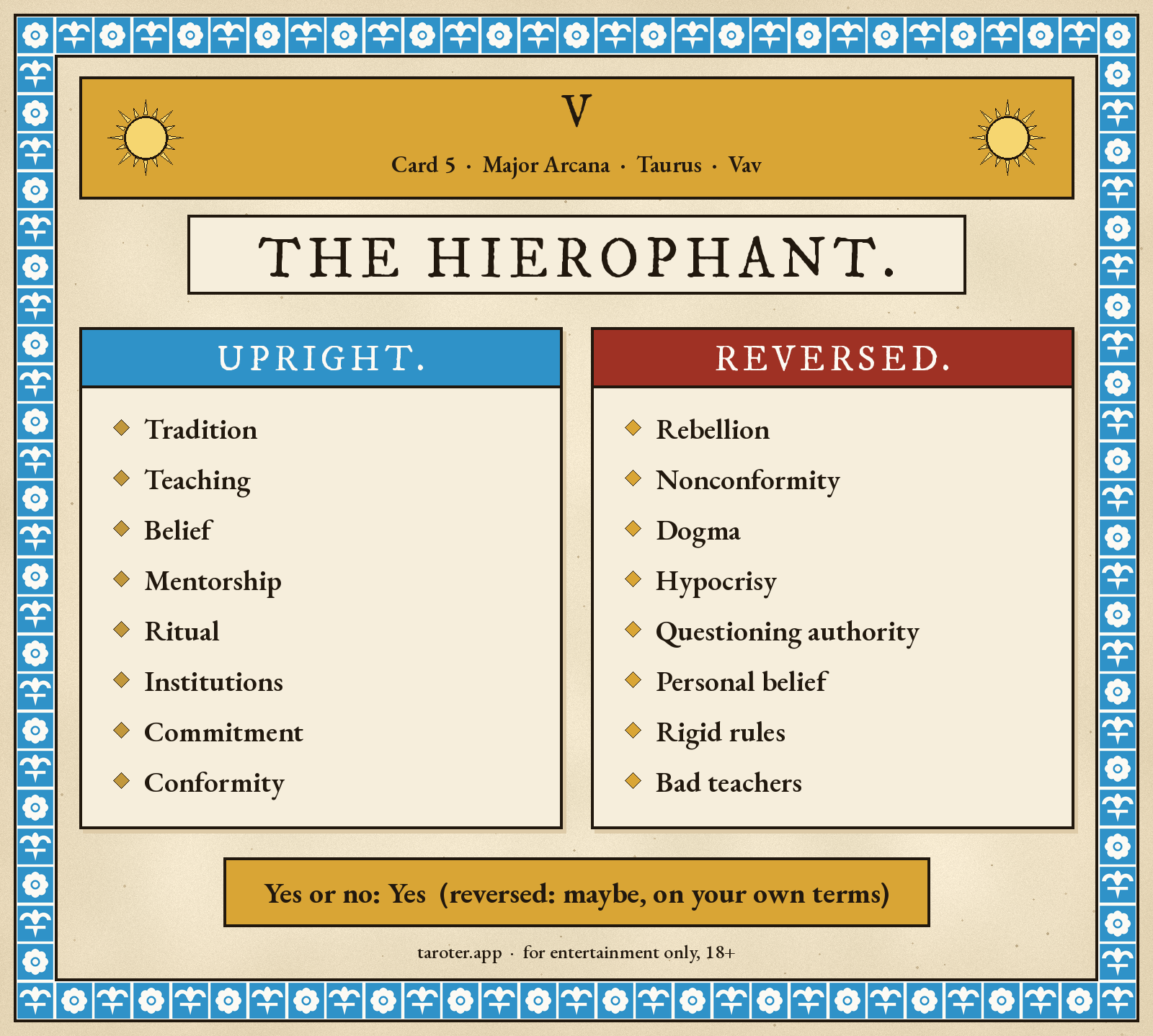
| Number | 5 (V) |
| Arcana | Major |
| Element | Earth |
| Astrology | Taurus (Golden Dawn) |
| Hebrew letter | Vav (ו) |
| Upright keywords | tradition, teaching, belief, institutions, mentorship, ritual, commitment, conformity |
| Reversed keywords | rebellion, nonconformity, dogma, hypocrisy, questioning authority, personal belief |
| Yes or no | Yes, if you follow the rules (reversed: maybe, on your own terms) |
Where the Hierophant comes from
In the early Italian decks, this card was simply the Pope. That made complete sense in 15th-century Italy. The trump sequence followed the structure of the world as people understood it, and right alongside the earthly rulers (the Empress and Emperor) sat the spiritual rulers: the Popess (later the High Priestess) and the Pope. Together they made a neat set of four: two worldly powers, two religious ones.
In the Tarot de Marseille, he's Le Pape, card V. He's an old man in a triple tiara, holding a triple cross, raising his hand in blessing over two smaller figures in front of him, usually seen from behind. Two pillars often frame him. The design is almost identical to the later Rider-Waite-Smith card in its basic structure, which is unusual. A lot of cards changed a great deal between Marseille and Smith. This one mostly kept its bones.
The big change was the name. When Arthur Edward Waite and Pamela Colman Smith created their deck in 1909, they used the Hierophant, a title Waite took from the Golden Dawn and from ancient Greece. A hierophant was the priest at Eleusis who revealed the sacred mysteries to initiates. The word means something like "one who shows the holy things." Some 18th and 19th century decks had already replaced the Pope with figures like Jupiter or a generic high priest, partly to avoid offending the Church, and the occult revival pushed the card further toward the idea of esoteric teaching in general.
Waite himself makes a point of this in The Pictorial Key to the Tarot (1910). He says the card represents the outer, public form of religion, the doctrine everyone can see, as opposed to the High Priestess, who guards the hidden, inner side. His divinatory meanings for the upright card include marriage and alliance, captivity and servitude, and also mercy and goodness. That mix tells you something: the Hierophant binds people together, and binding cuts both ways. For the reversed card, Waite lists things like society, understanding, concord, and overkindness or weakness.
How the meaning shifted
Older readings leaned heavily on the Church: religion, marriage ceremonies, clergy, moral authority. Over the 20th century, readers broadened him into any institution or tradition that holds shared beliefs: schools, universities, professional bodies, families, cultural communities, even well-established companies. He also became the card of mentorship: the one-on-one relationship where knowledge passes from someone who has it to someone who wants it.
Modern readers also pay a lot of attention to the reversed side, because questioning tradition is a bigger part of most people's spiritual lives than it used to be. These days the reversed Hierophant can be a perfectly healthy sign. Sometimes it's the most honest card in the spread.
Where this card sits in the Fool's Journey
Just before the Hierophant, the Fool met the Emperor and learned that the world has structure: laws, borders, authority, plans. That's the outer framework of society.
The Hierophant adds the inner framework: values, beliefs, rituals, and the shared stories that tell a group what it means to be part of it. Here the Fool becomes a student for the first time. He's told what his people believe, how they mark weddings and funerals, which books are worth reading, and what a good life looks like. Agreeing with all of it can wait. For now, his job is to learn it. You can't really rebel against a tradition you never understood.
After the Hierophant comes the Lovers. That's where the Fool takes everything he's been taught and faces a choice that's entirely his own. The Hierophant gives you the rulebook. The Lovers ask what you'll do when your heart and the rulebook disagree.
The symbolism, detail by detail
Smith's Hierophant is very symmetrical, almost like a formal church painting. Here's what's on it.
The figure on the throne. A religious leader, seated and facing forward, in heavy ceremonial robes. He's calm and formal. He isn't going anywhere, and neither is his institution.
The triple crown. He wears a three-tiered crown, like a papal tiara. The three tiers are often read as the three worlds or levels of existence (physical, mental or emotional, and spiritual), or as authority over three realms. Whatever you take them to mean, they say his authority is layered and wide.
The raised right hand. His right hand is lifted in a sign of blessing, with two fingers pointing up and two folded down. This is a traditional gesture of benediction. Esoteric readers see in it the idea of "as above, so below": he points to heaven while his other fingers point to earth, connecting the two.
The triple cross staff. In his left hand is a staff topped with a cross that has three crossbars. Again three levels, and again a symbol of religious authority. Where the Emperor holds an orb and scepter of worldly rule, the Hierophant holds a staff of spiritual rule.
The red outer robe. Red over lighter undergarments of white and blue. Red is active authority and outward power; the lighter layers underneath hint at purity and inner wisdom. He wears his inner life on the inside.
The two gray pillars. He sits between two stone pillars. Compare this with the High Priestess, who sits between one black and one white pillar marked B and J. Her pillars stand for opposites and mystery. His are matching and gray, more like the columns of a building. This is the established church, the hall of learning, the solid, public institution. Hers is the veil of secrets.
The crossed keys. At his feet lie two crossed keys, one gold and one silver. Keys are a traditional papal symbol (the keys of the kingdom), and here they're often read as the keys to knowledge: one for the outer, conscious mind and one for the inner, hidden one, or the sun and the moon. The point is that he holds access. He can open doors for you, and he can choose not to.
The two kneeling figures. Two acolytes or monks with shaved crowns kneel before him with their backs to us. One wears a robe decorated with red roses, the other with white lilies. You've seen these flowers before on the Magician's card: roses for passion and desire, lilies for purity and thought. The two followers can be read as two sides of human nature, both being brought under the same teaching. They're also simply the students, the congregation, the people being initiated.
The symmetry. Notice how balanced the card is: two pillars, two keys, two followers, one central figure. Everything is in its place. That's the strength of tradition, and also its limit. There's not much room on this card for anything unexpected.
Astrology, element, and the Hebrew letter
The Golden Dawn linked the Hierophant to Taurus, a fixed Earth sign ruled by Venus. At first that might seem like an odd match for a religious leader. But Taurus is steady, loyal, patient, and attached to what lasts. Taurus distrusts change for its own sake, values security, and builds slowly. That's a pretty good description of how traditions work. They survive because they're stubborn.
The Venus connection adds something too. Traditions carry beauty along with the rules: music, ceremony, food, incense, the beauty of doing something the way your grandparents did. Taurus is very sensual, and so, quietly, is ritual.
The Hebrew letter is Vav (ו), which means "nail" or "hook," the thing that joins two pieces together. That fits beautifully. The Hierophant's job is to connect: heaven and earth, teacher and student, past and present, the individual and the community. In Hebrew grammar, Vav also works as the word "and," the joiner of phrases.
If you're a Taurus or have a lot of Earth in your chart, you may relate to the Hierophant's love of the familiar. And you may also know how hard it can be to let go of a tradition once it's stopped serving you.
The Hierophant upright
Keywords: tradition, convention, institutions, belief systems, teaching, mentorship, learning, ritual, commitment, community, conformity.
When the Hierophant shows up upright, the answer to your question probably lies in something established. A tried-and-true method, a qualified expert, a formal process, an existing community, or a tradition you belong to. This is not the moment to reinvent the wheel. Someone has done this before, and you can learn from them.
He's very often a teacher card. You might be about to study something formally: a degree, a certification, an apprenticeship, a course. Or you might meet a mentor, someone who's walked the road ahead and is willing to show you the way. The upright Hierophant asks you to be a good student: humble, curious, and willing to learn the basics before you start improvising.
He's also a card of belonging. Traditions give us a place in a group. The Hierophant can point to joining a community, recommitting to your faith or cultural roots, or finding people who share your values. In a lonely season, that can be exactly what you need.
And he's the card of formal commitment. Marriages, contracts, vows, oaths, official ceremonies. Anything that makes a promise public and binding. Waite's list included marriage for a reason.
Sometimes he points to conformity, plain and simple. Doing it the expected way. That can be fine. Sometimes the expected way is expected because it works.
The Hierophant reversed
Keywords: rebellion, nonconformity, questioning tradition, personal spirituality, dogma, rigid beliefs, hypocrisy, bad teachers, breaking the rules.
The reversed Hierophant has two very different flavors, and this is one of the cards where it matters a lot which one you're dealing with.
Breaking free
The healthy version. You're questioning beliefs you were handed, and you've noticed that some of them don't fit. Maybe you're leaving a religion, a family expectation, a career path everyone assumed you'd take, or a relationship structure that never felt right. You're drawing your own map to the sacred.
This version of the card can feel uncomfortable, even guilty. But it's often a sign of growth. Every tradition was started by someone who did things differently once.
Dogma and hypocrisy
The unhealthy version. Rules followed blindly, or enforced without compassion. A teacher who abuses their position. An institution that cares more about its reputation than its people. A belief system that's become rigid, judgmental, and afraid of questions. It can also be you: clinging to "the right way" so tightly that you can't see anyone else's point of view.
There's a sneaky third version, too: rebellion for its own sake. Rejecting every tradition just because it's a tradition, without asking whether any of it had value. That's just following the opposite rules, and calling it freedom.
How to tell which one it is
Ask: is this about me outgrowing something, or about something (or someone) refusing to grow? If the reversed Hierophant feels like relief, it's probably the breaking-free version. If it feels like a heavy weight or someone pressing down on you, it's probably dogma. If it feels like defiance with no real direction, check whether you're rebelling or just reacting.
The Hierophant in love and relationships
Upright
If you're single: you might meet someone through traditional channels: friends, family, a religious community, work, or a formal event. The Hierophant also suggests someone with solid values who's looking for something serious. It can also nudge you toward the kind of relationship you actually want long-term, even if it's more conventional than you thought you'd like.
If you're in a relationship: commitment, often in a formal way. Engagement, marriage, moving in, meeting the families, or taking vows of some kind. It's also a good card for couples who share values and want to build their life on common ground. The Hierophant can point to couples counseling or advice from a trusted mentor.
For feelings ("how do they feel about me?"): they see you as serious, long-term material. They may be thinking about commitment, family approval, and whether you share the same values. They may also be fairly traditional about how relationships should progress.
Reversed
If you're single: you may be rejecting traditional dating paths, which can be freeing. Or you may be trying to fit into a relationship model that doesn't suit you. It can also point to family or cultural pressure about who you "should" be with.
If you're in a relationship: differing values, family disapproval, or a relationship that feels too constrained by expectations. It can also mean you're choosing an unconventional structure that works for you, even if others don't understand it. Look at the surrounding cards to see whether it's friction or freedom.
For feelings: they may be pulling away from commitment, or feeling torn between what they want and what's expected of them.
The Hierophant in career and work
Upright
Large organizations, formal hierarchies, established industries, government, education, religion, law, or finance. The Hierophant favors following procedures, getting qualified, and learning from experienced people. He's a strong card for training, apprenticeships, certifications, and mentorship. If you're thinking about going back to school, the Hierophant is generally encouraging.
He can also mean working within the system. Sometimes the best way to change an institution is from the inside.
Reversed
Frustration with bureaucracy, rigid rules, or a workplace culture that rewards fitting in over doing good work. It can also be a sign that you're ready to leave the established path: freelancing, starting something of your own, or doing your job in a less conventional way. Watch out for bad mentors or authorities who use their position unfairly.
The Hierophant in money and finances
Upright
Conservative, sensible money choices. Traditional banks, established investments, insurance, pensions, getting advice from a qualified professional. The Hierophant is steady and unflashy with money, and he does it the way it's always been done because it tends to work.
Reversed
Either a desire to break from conventional financial wisdom (which can go well or badly), or getting burned by institutions or advisors you trusted. Look closely at any financial arrangement that relies on "trust me, this is how it's done." Reversed, the Hierophant asks you to understand the rules before you follow them.
The Hierophant in health and wellbeing
Tarot isn't a substitute for medical advice. If you have health concerns, see a professional.
Upright
Follow established, evidence-based advice. See a qualified professional, stick with the treatment plan, and take sensible, well-tested approaches. Taurus is traditionally linked with the throat and neck, so some readers take the card as a reason to pay attention there.
Reversed
You may feel your current approach has stalled and want to explore other options. That's fine, but talk to a professional before dropping any treatment. It can also point to frustration with the healthcare system or feeling unheard by people in authority.
The Hierophant in spirituality
This is the Hierophant's home turf. Upright, he points to organized spirituality: a religion, a lineage, a tradition with teachers, texts, and practices. He can mean finding a spiritual teacher, joining a community, studying sacred texts, or deepening a practice you were raised with. He's also the card of ritual, and how doing something sacred over and over can change you.
Reversed, he's the seeker who leaves the temple to find God (or meaning, or truth) on their own. Personal spirituality, unconventional paths, questioning doctrine. It can also be a warning about spiritual leaders or groups that demand obedience and punish questions. Real teachers welcome hard questions.
The Hierophant by spread position
Past: your upbringing, your traditions, and the beliefs you were taught. A teacher or institution that shaped you.
Present: you're learning something, working within a system, or being asked to commit to something formal. Or you're questioning the beliefs that have guided you.
Future: something to reflect on as you look ahead: a mentor, a formal commitment, a course of study, or a new connection to a tradition or community.
Advice: learn from people who've done this before. Follow the proven path for now. Seek guidance before you improvise.
Obstacle or challenge: rigid rules, a stubborn institution, or a belief system that's holding you back. Or your own resistance to learning from others.
Outcome: a conventional, stable, socially recognized result. A ceremony, a qualification, a commitment made official.
Hopes and fears: you may want to belong and fear being swallowed by the group, or want freedom and fear losing your roots.
The Hierophant as a yes or no
Upright, the Hierophant is generally a yes, as long as you go about it the traditional way. Follow the rules, use the proper channels, and the answer is favorable.
Reversed, it's more of a maybe, or a yes on your own terms. The conventional route probably won't work here, but a different one might.
The Hierophant in combination with other cards
The Hierophant + The Lovers: marriage, a committed partnership, or a values-based decision about love. One of the most traditional "wedding" pairings in tarot.
The Hierophant + The High Priestess: outer teaching meets inner knowing. A spiritual teacher, deep study, or the balance between religion and intuition.
The Hierophant + The Emperor: institutions and authority. Government, law, big organizations, formal systems. Strongly establishment.
The Hierophant + The Devil: dogma, control through belief, or a group that demands too much. Look carefully at who benefits from the rules.
The Hierophant + The Fool: an unconventional student, or a beginner entering a tradition. Learning something completely new with fresh eyes.
The Hierophant + Two of Cups: a formal union or commitment between two people. Engagement, marriage, or a partnership agreement.
The Hierophant + Three of Pentacles: apprenticeship, collaboration with experts, learning a craft under supervision.
The Hierophant + Page of Pentacles: a student, formal study, or the beginning of an education.
The Hierophant + Five of Pentacles: feeling shut out of a community or institution, or seeking help from a charity or support group.
The Hierophant + Judgement: a calling, a spiritual awakening within a tradition, or a reckoning with what you were taught.
Common mistakes when reading the Hierophant
Reading it as only religious. The Hierophant can be any institution, teacher, or shared belief system: a university, a medical board, your family's way of doing Thanksgiving.
Treating it as automatically boring or oppressive. Tradition gives us belonging, meaning, and knowledge we'd never figure out alone. Upright, the card is mostly positive.
Treating the reversal as automatically bad. The reversed Hierophant is often healthy questioning. Don't read it as a warning by default.
Forgetting the students. The two kneeling figures matter. Sometimes the card is about you as the learner, or you as the teacher, with the institution in the background.
Confusing him with the High Priestess. She is hidden, intuitive, inner knowledge. He's public, taught, outer knowledge. They're partners with separate jobs.
The Hierophant as a person
As a person, the Hierophant is a teacher, mentor, counselor, priest, professor, or wise elder. They know the rules, they know the history, and they love passing it on. They're reliable, principled, and often deeply kind. They can also be preachy, judgmental, or attached to "the way it's always been done." Think of the professor who's taught the same class for thirty years, still gets excited about it, and will absolutely notice if you didn't do the reading.
It can also describe someone who values convention: the friend who plans the traditional wedding, keeps every family holiday going, and calls their grandmother every Sunday.
Journal prompts for the Hierophant
- What beliefs did I inherit that I've never actually examined?
- Which traditions in my life still feel meaningful, and which feel empty?
- Who has been a real teacher to me? What did they give me?
- Where am I resisting good advice just because it came from authority?
- Where am I following rules I don't believe in?
- What would I want to pass on to someone younger than me?
Frequently asked questions
Is the Hierophant a good or bad card? Mostly good. It represents learning, tradition, community, and commitment. Reversed, it can point to dogma or rebellion, depending on context.
What's the difference between the Hierophant and the Pope? They're the same card. Older decks, like the Tarot de Marseille, called it the Pope. Waite and the Golden Dawn renamed it the Hierophant, after the priest who revealed the sacred mysteries in ancient Greece.
Does the Hierophant mean marriage? It can. It's one of tarot's traditional marriage cards, especially next to the Lovers or the Two of Cups.
What does the Hierophant mean as feelings? Seriousness, commitment, and traditional intentions. They may be thinking about the long term and whether you'd fit into their life and values.
What zodiac sign is the Hierophant? Taurus, in the Golden Dawn system. That makes it an Earth card, ruled by Venus.
What does it mean if the Hierophant keeps showing up? You're in a learning phase, or you're being asked to look at your relationship with tradition and belief. If it keeps coming up reversed, it may be time to question something you've accepted without thinking.
Where the journey goes next
The Fool has learned what his people believe. Next, he faces the Lovers, card six: a choice that nobody else can make for him, where love, values, and the rules he's just been taught all meet. That's tomorrow's card.
If you missed the card before this one, the Emperor article covers the structure the Hierophant builds on. You can also see the Hierophant's upright and reversed meanings and how it appears in readings on the Hierophant card page. Or draw a card in Taroter and see what the teacher has to say.
Taroter
Author
Related articles

The Emperor Tarot Card Meaning: Structure, Authority, and the Art of Holding Things Together
The Emperor is card four, and he is the least fun person at the party. He's also the reason there's a party at all: someone booked the...

The Empress Tarot Card Meaning: Abundance, Creativity, and the Art of Growing Things
The Empress is card three, and she's the first card in the Major Arcana that feels like you could lie down in it. The Magician worked under...
The High Priestess Tarot Card Meaning: Intuition, Secrets, and the Space Between
The High Priestess is card two, and she's the first card in the deck that doesn't want to tell you everything. The Magician stood in bright...