The High Priestess Tarot Card Meaning: Intuition, Secrets, and the Space Between
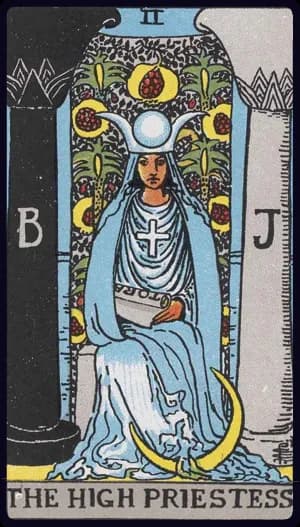
The High Priestess is card two, and she's the first card in the deck that doesn't want to tell you everything. The Magician stood in bright daylight with all his tools out on the table. The High Priestess sits in the dark between two pillars, a scroll half-tucked into her robe, a veil hanging behind her that hides whatever's back there. She knows things. She's just not going to explain them in a bullet list.
This is the third post in our one-card-a-day series on the Major Arcana, which started with the Fool. We'll look at where the card came from (it involves a legendary female pope, which is a fun story), what every detail on the Rider-Waite-Smith version means, how to read it upright and reversed in love, work, money, health, and spiritual life, how it changes by spread position, which cards it pairs with, and the mistakes people make when it shows up.
Quick reference
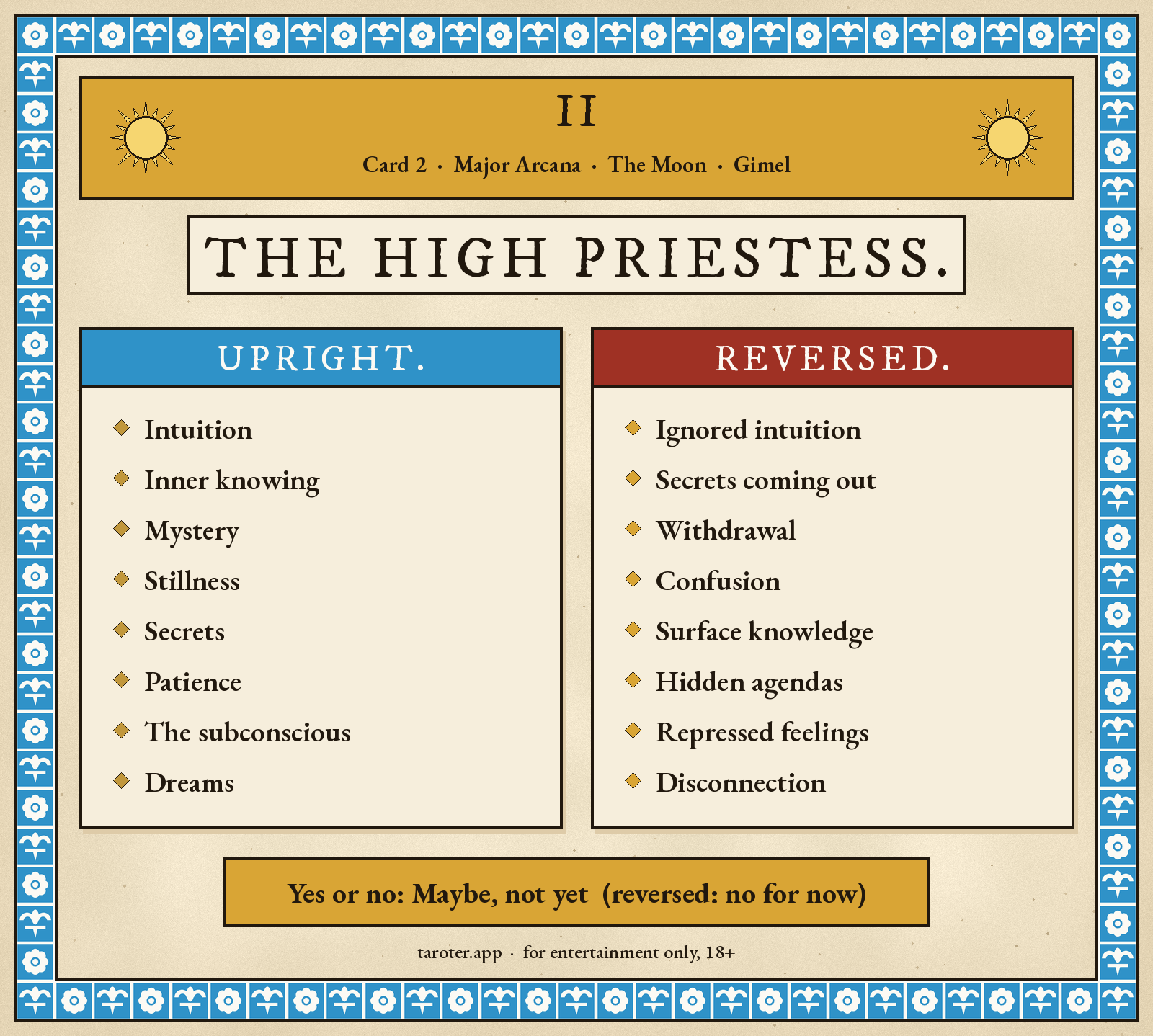
| Number | 2 |
| Arcana | Major |
| Element | Water |
| Astrology | The Moon |
| Hebrew letter | Gimel (ג) |
| Upright keywords | intuition, mystery, inner knowing, stillness, secrets, patience, the subconscious |
| Reversed keywords | ignored intuition, secrets coming out, withdrawal, confusion, surface knowledge |
| Yes or no | Maybe, or not yet (the answer isn't ready to be known) |
Where the High Priestess comes from
In the early Italian decks and in the Tarot de Marseille, this card wasn't a priestess at all. She was the Popess: la Papessa in Italian, La Papesse in French. She's a woman dressed in religious robes, wearing the triple papal crown, with an open book on her lap.
That's a strange thing to put on a playing card in 15th-century Europe, and people have argued about it ever since. A few of the popular theories:
Pope Joan. A medieval legend told of a woman who disguised herself as a man, rose through the Church, and became pope, until she gave birth during a procession and the secret came out. Historians agree it never happened, but the story was well known when the first tarot decks were painted, and the Popess may have been a nod to it.
Sister Manfreda. One of the oldest surviving decks, the Visconti-Sforza, was made for the ruling family of Milan. A distant relative of that family, Maifreda da Pirovano, was elected "pope" by a small heretical group in the late 1200s and was burned for it. Some historians think the Popess card is her.
An allegory of faith. The simplest explanation: she stands for Faith or the Church, the same way other trumps stand for Justice, Temperance, and Strength.
Whatever she started as, the idea of a woman holding sacred, hidden knowledge stuck. When the 18th- and 19th-century occultists got hold of tarot, the Popess became a figure of esoteric wisdom, and some decks renamed her Juno to steer away from Church imagery. The Golden Dawn turned her into the High Priestess, and in 1909 Arthur Edward Waite and Pamela Colman Smith gave her the form most people know today.
Smith took out the papal crown and the open book. In their place: a horned lunar crown, a rolled scroll that's mostly hidden, two pillars, and a veil. The Marseille Popess is reading. Smith's High Priestess is guarding. That shift matters. The knowledge on this card comes to you when you're quiet enough to receive it.
In The Pictorial Key to the Tarot (1910), Waite describes her as the guardian of secret doctrine and connects her to the Shekinah, the divine presence in Jewish mysticism. His meanings for the upright card are things like secrets, mystery, the future not yet revealed, silence, tenacity, and wisdom. Reversed, he lists passion, conceit, and surface knowledge. That last one is useful. The reversed Priestess often points at someone who thinks they understand more than they do.
Why two?
One is a single point. Two is the first relationship: this and that, light and dark, inside and outside. The High Priestess sits exactly in that space, between a black pillar and a white one. She's about duality, and also about what lives in between. If the Magician says "I will," the High Priestess says "wait, and listen."
The symbolism, detail by detail
There's a lot packed into this quiet card. Here's what's actually on it.
The two pillars. She sits between a black pillar marked B on the left and a white pillar marked J on the right. These are Boaz and Jachin, the two bronze pillars that stood at the entrance to Solomon's Temple in the Bible. Black and white, receptive and active, unknown and known. The High Priestess doesn't pick a side. She sits at the threshold between them, which is where she's most powerful.
The veil. Behind her hangs a veil stretched between the pillars, decorated with pomegranates and palm leaves. It hides whatever is behind her, though if you look closely you can see a glimpse of water beyond it. This is the veil between the conscious and unconscious, or between this world and whatever's beyond. The High Priestess is the one who can see past it. She's also the one who decides how much you get to see.
The pomegranates. Pomegranates are full of seeds, so they're an old symbol of fertility and abundance. They're also tied to the Greek myth of Persephone, who ate pomegranate seeds in the underworld and had to return there part of every year. So they carry two meanings at once: life and fertility on one hand, the underworld and hidden depths on the other. The pomegranates come back on the Empress's robe in the next card.
The scroll. She holds a scroll in her lap, partly covered by her robe. You can see the letters TORA on it. That can be read as the Torah, the Hebrew law, and it can also be read as an anagram of TAROT (Waite liked that kind of wordplay). Either way, the important part is that it's half hidden. She has the knowledge, but she isn't reading it out loud.
The horned crown. On her head is a crown made of a full moon with a crescent on either side, often read as the waxing, full, and waning moon. This ties her to the Moon, cycles, and to goddess figures like Isis and Hathor, who wore horned headdresses.
The crescent at her feet. A crescent moon rests at her feet. More moon imagery: intuition, the night, and the rhythms of the body and emotions. Some readers connect it to the woman in the Book of Revelation who stands with the moon under her feet.
The cross on her chest. A simple equal-armed cross sits on her breast. It's a symbol of balance, the four elements held in harmony, and of the meeting point between the spiritual and material.
The blue robe. Her robe is blue, the color of water, depth, and calm. It falls in long folds down to the floor, and some readers see it as flowing like water out of the bottom of the card. Water is the element of emotion and the subconscious, so it fits.
The stone seat. She sits on a plain stone block. It's steady and unmoving. She's not going anywhere, and she's in no hurry.
The overall mood. Compare this card to the Magician. His background was bright yellow, full daylight. Hers is darker and cooler, mostly blues and grays and black. The Magician acts. The High Priestess waits. That contrast is the heart of reading these two cards.
Astrology, element, and the Hebrew letter
In the Golden Dawn system, the High Priestess is linked to the Moon and the Hebrew letter Gimel (ג).
The Moon is the obvious match, and the card practically shouts it with three separate moon symbols. In astrology the Moon rules emotions, instincts, memory, the inner life, and the parts of us that operate below conscious thought. It changes shape constantly but is always the same Moon. That's the High Priestess: steady underneath, shifting on the surface.
The Moon rules the sign Cancer, so people with strong Cancer placements, or a prominent Moon in their chart, often feel at home with this card. Its element is Water, which brings in emotion, receptivity, and depth.
Gimel is the third letter of the Hebrew alphabet, and the word is usually connected to "camel." That sounds random until you look at the Tree of Life. In the Golden Dawn system, the High Priestess's path is the long one that runs straight down the middle, from Kether (the crown, pure divine source) to Tiphareth (beauty, the heart). It crosses the Abyss, the great gap between the highest spiritual levels and everything below. A camel is how you cross a desert. Gimel is how the soul crosses that empty space. It's a lonely, quiet path, which suits a card about inner knowing.
Where the High Priestess sits in the Fool's Journey
The Fool has just met the Magician and learned that skill and will are real. They can make things happen. Then they walk between two pillars into a much quieter room.
Here the lesson is the opposite one: some things have to be received. The High Priestess teaches the Fool to slow down, pay attention to dreams and hunches and gut feelings, and accept that some answers arrive on their own schedule. The Magician is the conscious mind. The High Priestess is the deeper mind underneath it. Readers often treat them as a pair, the "doing" and the "knowing." You need both.
After this, the Fool meets the Empress, card three. The High Priestess holds the seed of something in the dark. The Empress is what happens when that seed grows into the world: abundance, creativity, the body, nature. The Priestess is potential held in silence. The Empress is that potential bearing fruit.
The High Priestess upright
Keywords: intuition, inner knowing, mystery, the subconscious, stillness, patience, secrets, hidden knowledge, dreams, receptivity.
When the High Priestess shows up upright, the main message is: trust what you already know. You probably have a feeling about the situation you're asking about. Maybe you can't explain it, and maybe you've been talking yourself out of it because it isn't "logical." The High Priestess says the feeling counts.
She's also a card of stillness. Where the Magician says act, she says wait a while, because you don't have all the information yet and pushing will only muddy the water. Some situations need you to sit with them for a while before the answer becomes clear. That can be frustrating if you're the type who likes to fix things fast.
There's often something hidden when this card appears. Information that hasn't come out yet, something going on behind the scenes, a secret (yours or someone else's), or just a part of the situation you can't see from where you're standing. Often it just means the picture isn't finished yet.
And she's about the inner life: dreams, meditation, journaling, quiet time, any practice that helps you hear yourself think. If your life has been loud and busy lately, she's asking for some silence. The answers you're looking for will come from listening.
The High Priestess reversed
Keywords: ignoring intuition, disconnection, secrets revealed, hidden agendas, withdrawal, confusion, surface knowledge, repressed feelings.
Reversed, the High Priestess can go two ways, and they're kind of mirror images.
Shutting her out
You're not listening to your intuition. Maybe you had a gut feeling and overrode it because someone else seemed more sure. Maybe you're so busy that you've lost touch with what you actually think or want. Maybe you've decided feelings don't count unless you can back them up with evidence. This version of the reversed Priestess often shows up as a vague sense of being off, unsettled, or disconnected from yourself.
It can also be the "surface knowledge" Waite mentions: acting like you understand something deeply when you've only skimmed it. Or trusting someone who sounds wise but hasn't actually done the inner work.
Getting lost in her
The opposite. You're so far inside your own head that you can't get out. Overanalyzing every feeling, reading signs into everything, withdrawing from people, keeping too many secrets. This is the Priestess's quiet turned into isolation. Intuition is great, but if you're using "my intuition says" to avoid every hard conversation or decision, it's become a hiding place.
Secrets coming out
There's one more common reading for the reversed High Priestess: what was hidden comes into the open. The veil lifts. A secret gets revealed, a hidden agenda becomes obvious, or something you've been keeping from yourself finally surfaces. This can be uncomfortable, but it often clears the air.
How to tell which one it is
Ask: am I ignoring a feeling, or hiding inside one? If you've been overriding your gut, it's the first kind. If you've been using your inner world as a place to avoid the outer one, it's the second. And if the cards around it are dramatic ones like the Tower or Judgement, lean toward the "secrets coming out" reading.
The High Priestess in love and relationships
Upright
If you're single: take your time. The High Priestess moves slowly in love. She suggests getting to know someone slowly, trusting your first impressions, and paying attention to how you feel around people more than to what they say. There may be someone interested in you who hasn't said so yet. There's also an air of mystery here. You might be the one who's a bit hard to read right now, and that's fine.
If you're in a relationship: pay attention to what isn't being said. The High Priestess can point to deep emotional and intuitive connection, the kind where you know what the other person is feeling without asking. It can also point to something unspoken that needs space to come out on its own. Don't force it. Create room for it.
For feelings ("how do they feel about me?"): they're drawn to you, but they're keeping it to themselves. There's a lot going on inside that they aren't showing. They may be attracted to you partly because there's something about you they can't quite figure out.
Reversed
If you're single: you might be ignoring red flags your intuition is waving at you. Or you're so guarded that nobody can get close. It can also point to a connection with someone who's hiding something.
If you're in a relationship: secrets, emotional distance, or a gap between what's said and what's felt. One person may be withdrawing. Or a secret is about to come out. If you've had a nagging feeling that something's off, this card suggests you shouldn't brush it aside.
For feelings: they're confused about how they feel, or they're repressing it. They may be holding back for reasons you don't know about.
The High Priestess in career and work
Upright
The High Priestess at work usually says: don't rush, and don't share everything yet. If you're weighing a decision, gather information quietly and trust your read on the people and the situation. It's a good card for research, strategy, behind-the-scenes work, and fields that rely on insight, like counseling, psychology, writing, healing, teaching, and anything creative.
It can also mean there's information you don't have yet. Before you sign, commit, or make a big move, find out what's going on behind closed doors.
Reversed
Hidden agendas, office politics, information being kept from you, or you ignoring a gut feeling about a job or a colleague. It can also point to work that feels disconnected from your deeper values, the kind of job where you're going through the motions and the inner spark has gone quiet.
The High Priestess in money and finances
Upright
Keep your financial plans private for now. The High Priestess is a card of discretion. It's also a good time to quietly look into your options and hold off on big moves. If something about a deal feels off, even if you can't say why, listen to that.
Reversed
Hidden costs, fine print you didn't read, or financial information someone isn't sharing. It can also point to money issues you've been avoiding looking at. The veil is coming off, so it's better to look first.
The High Priestess in health and wellbeing
Tarot isn't a substitute for medical advice. If you have health concerns, see a professional.
Upright
Listen to your body. The High Priestess is about subtle signals, and she often shows up when your body is telling you something quietly. Rest, sleep, and inner balance are important here. Because of her lunar links, she's also traditionally associated with cycles, hormones, and reproductive health.
Reversed
Ignoring symptoms, or being disconnected from your body. It can also point to stress or anxiety that's been pushed down and is showing up physically. If something's been bothering you, don't wait for it to get louder before you get it checked.
The High Priestess in spirituality
This is the High Priestess's home turf. She's the guardian of mystery, the one who sits at the gate between what we know and what we don't. Upright, she encourages meditation, dreamwork, intuitive development, and any practice that quiets the mind enough to hear what's underneath. She's also a reminder that some spiritual knowledge only comes through direct experience.
If you've been feeling a pull toward tarot, astrology, meditation, or other inner practices, the High Priestess is often the card that says, yes, follow that.
Reversed, she can point to spiritual disconnection, a feeling that your practice has gone dry. Or she can warn against chasing secret knowledge for its own sake, collecting mysteries without actually being changed by them.
The High Priestess by spread position
Past: a time when you trusted your intuition, or a secret or hidden influence that still shapes the situation.
Present: you're being asked to slow down and listen. Part of the picture is still hidden. Your gut knows more than your head right now.
Future: a nudge to stay open. Ask yourself what you might understand if you gave this more time and quiet.
Advice: wait. Be quiet. Trust your instincts. Don't share everything, and don't force a decision before you're ready.
Obstacle or challenge: something hidden is in the way, or you're ignoring your intuition. Or you're too withdrawn to move forward.
Outcome: reflect on what a deeper understanding of the situation would look like for you. The resolution she points to is usually an inner shift, quieter than the big event you might be hoping for.
Hopes and fears: you may hope to find out the truth and fear what it is. Or you may want to trust yourself but be afraid you're wrong.
The High Priestess as a yes or no
The High Priestess is famously a maybe. More precisely, she's a "the answer isn't available yet." Something important is still hidden, or the situation needs more time to unfold. If you're pressed for a lean, ask yourself what your gut says, because that's literally what this card is about.
Reversed, she leans toward no for now, often because there's information you don't have that would change the picture.
The High Priestess in combination with other cards
The High Priestess + The Magician: intuition and action working together. You know what to do and you have the ability to do it. A very powerful pairing.
The High Priestess + The Empress: deep feminine wisdom and creativity. Can also point to pregnancy, fertility, or a creative project that's quietly growing.
The High Priestess + The Moon: a double dose of mystery. Intuition is strong, but so is confusion. Trust your feelings, but be aware that not everything is what it seems.
The High Priestess + The Hermit: a period of solitude, reflection, and inner work. Answers come from going inward.
The High Priestess + The Lovers: a hidden attraction, or a relationship decision that needs to come from the heart.
The High Priestess + The Tower: a secret explodes into the open. Sudden revelation.
The High Priestess + The Star: spiritual guidance and hope. Your intuition is pointing you toward healing.
The High Priestess + Seven of Swords: someone is keeping secrets for less-than-honest reasons. Trust your suspicion.
The High Priestess + Two of Swords: an inner standoff. You're avoiding a decision. The answer is inside you, but you have to stop blocking it.
The High Priestess + Page of Cups: intuitive messages, dreams, or a gentle emotional surprise. Pay attention to small signs.
Common mistakes when reading the High Priestess
Expecting her to give you a straight answer. She won't, and that's the point. If you draw the High Priestess and feel frustrated that the reading isn't clear, that frustration is the message. Something isn't ready to be known.
Reading every High Priestess as "someone is lying to you." Secrets are part of this card, but most of the time the hidden thing is just information that hasn't come out yet, or something inside you that you haven't looked at. Don't jump to betrayal unless the surrounding cards back it up.
Treating intuition as infallible. The upright High Priestess says trust your intuition. It doesn't say your every passing anxiety is a psychic message. Real intuition tends to be calm and steady. Fear tends to be loud and urgent.
Confusing patience with passivity. Waiting with the High Priestess is active. You're paying attention, gathering, listening. That's different from avoiding the issue and hoping it goes away.
Assuming it's always a woman. Like the Magician, the High Priestess can represent anyone of any gender who has her quiet, perceptive energy. Often it's you.
The High Priestess as a person
When the High Priestess represents someone in a reading, it's usually a person who's quiet, perceptive, and hard to read. They listen more than they talk. They tend to know things about people that they haven't been told. Friends come to them for advice because they see what others miss.
They can also be private to the point of seeming distant. You might know someone like this for years and still feel like there's a part of them you've never met. In the best version, they're a wise, calm presence. In the shadow version, they're withholding, secretive, or a little too comfortable keeping everyone at arm's length.
Journal prompts for the High Priestess
- What do I already know about this situation that I haven't let myself admit?
- When was the last time I trusted my gut? What happened?
- Where am I trying to force an answer that isn't ready yet?
- What am I keeping secret, and who is it protecting?
- What do my dreams keep trying to tell me?
- How can I make more quiet space in my life this week?
Frequently asked questions
Is the High Priestess a good card? Yes. She's about intuition, wisdom, and depth. She can be frustrating because she doesn't give quick answers, but she usually shows up to help you trust yourself. Reversed, she warns about ignoring your gut or about secrets, but she's still pointing toward clarity.
Does the High Priestess mean someone is hiding something? Sometimes. More often, it means something isn't known yet, or that the answer is inside you. Look at the other cards for context.
What does the High Priestess mean as feelings? Quiet, deep attraction they're keeping to themselves. They're interested but cautious, and they may be hard to read. Reversed, they may be confused or repressing what they feel.
What zodiac sign is the High Priestess? She's ruled by the Moon, so she's connected to Cancer, the sign the Moon rules.
Is the High Priestess a pregnancy card? Some readers see it that way because of the Moon, the pomegranates, and her connection to cycles and hidden growth. The Empress is the more common pregnancy card, though. On its own, the High Priestess more often points to potential that hasn't shown itself yet.
What's the difference between the High Priestess and the Magician? The Magician is conscious action: focus, skill, getting things done in the open. The High Priestess is inner knowing: intuition, patience, and the things that happen below the surface. He acts. She listens.
Where the journey goes next
The Fool has learned to act and learned to listen. Next, they step out from behind the veil into a garden, where the Empress sits among ripening wheat and shows what happens when all that quiet potential finally grows into something you can touch: abundance, creativity, comfort, and care. That's tomorrow's card.
If you missed it, go back to yesterday's guide to the Magician, the High Priestess's opposite and partner. And you can find her upright and reversed meanings at a glance on the High Priestess card page.
Curious whether she'd turn up for you today? Pull a card on Taroter and sit with whatever comes up. It's for entertainment and reflection, and it's 18+.
Taroter
Author
Related articles

The Hierophant Tarot Card Meaning: Tradition, Teachers, and What You Choose to Believe
The Hierophant is card five of the Major Arcana, and the Hierophant tarot card meaning starts with a reputation problem. People see a man...

The Emperor Tarot Card Meaning: Structure, Authority, and the Art of Holding Things Together
The Emperor is card four, and he is the least fun person at the party. He's also the reason there's a party at all: someone booked the...

The Empress Tarot Card Meaning: Abundance, Creativity, and the Art of Growing Things
The Empress is card three, and she's the first card in the Major Arcana that feels like you could lie down in it. The Magician worked under...