The Emperor Tarot Card Meaning: Structure, Authority, and the Art of Holding Things Together

The Emperor is card four, and he is the least fun person at the party. He's also the reason there's a party at all: someone booked the venue, paid the deposit, and made sure the fire exits weren't blocked. That's the Emperor. He's structure, rules, boundaries, plans, and the kind of authority that keeps things standing when everyone else would rather not think about it.
A lot of people flinch when he shows up. He looks stern, he's sitting on a block of stone, and his mountains don't have a single tree on them. But the Emperor is one of the most useful cards in the deck once you stop reading him as a scolding. He's the part of life (and the part of you) that turns good intentions into something that actually holds.
This is post four in our series on the Major Arcana, one card a day. We'll cover where the Emperor came from, every symbol on the Rider-Waite-Smith card, his astrology, how to read him upright and reversed in love, work, money, health, and spirituality, plus spread positions, combinations, and the mistakes readers make with him.
Quick reference
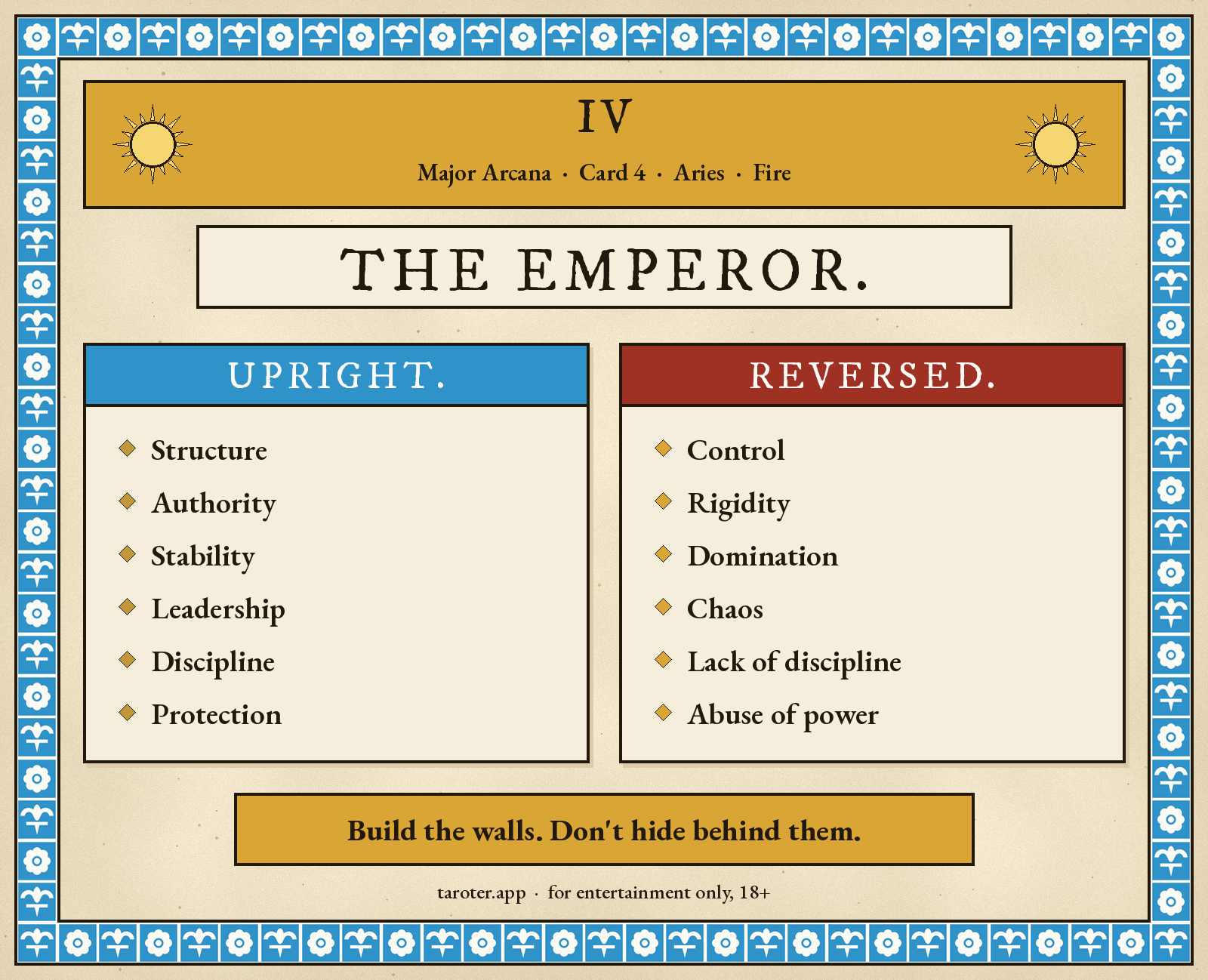
| Number | 4 (IV) |
| Arcana | Major |
| Element | Fire |
| Astrology | Aries (Golden Dawn) |
| Hebrew letter | Heh (ה) |
| Upright keywords | structure, authority, stability, leadership, discipline, protection, fatherhood |
| Reversed keywords | control, rigidity, domination, chaos, lack of discipline, abuse of power |
| Yes or no | Yes (reversed: no, or not on these terms) |
Where the Emperor comes from
The early Italian tarot decks of the 1400s included an Emperor among the trumps almost from the start, and it's easy to see why. Renaissance Italy lived under the long shadow of the Holy Roman Emperor, the highest secular ruler in the Christian world. The trump sequence was a kind of social ladder, and the Emperor sat near the top of the worldly half of it, just above the Empress and below the Pope.
In the Tarot de Marseille, he's L'Empereur, card IIII. He's usually drawn in profile, seated or half-leaning on his throne, with his legs crossed. He holds a scepter topped with an orb or a cross, and a shield with a black eagle (the imperial symbol) rests at his feet. He looks relaxed and in charge, like a man who doesn't need to stand up to prove anything. His crossed legs get a lot of attention from Marseille readers, since the shape echoes the figure four.
When Arthur Edward Waite and Pamela Colman Smith made their deck in 1909, they kept the core idea but changed the mood. Smith's Emperor faces you head on. He sits on a heavy stone throne in a red, rocky landscape, wearing armor under his robes. The Marseille Emperor looks comfortable with power. Smith's looks like he earned it and is still guarding it.
Waite's Pictorial Key to the Tarot (1910) gives the upright Emperor meanings like stability, power, protection, realization, aid, reason, and conviction, and describes him as a figure of executive will. For the reversed card, his list is a bit surprising: benevolence, compassion, and credit sit alongside obstruction and immaturity. Modern readers mostly ignore the soft side of that reversed list and read the reversed Emperor as power gone wrong, which is closer to how most people experience it.
How the meaning shifted
Older readings treated the Emperor fairly literally: a powerful man, a ruler, a patron, a father. That's still a valid reading. But over the 20th century, readers started turning the card inward. The Emperor became the internal ruler too: your own sense of order, your ability to set boundaries, your willingness to make a plan and stick to it. These days he's as likely to represent your relationship with discipline as he is a boss or a dad.
Where this card sits in the Fool's Journey
Right before the Emperor, the Fool spent time with the Empress: abundance, comfort, growth, nature doing its thing without needing a schedule. It's lovely there. But nothing in the Empress's garden is fenced, labeled, or protected. Things grow, and things also get trampled.
The Emperor is the next lesson. Here the Fool learns that the world has rules, and that some of those rules are worth having. Walls keep things safe. Agreements let strangers trust each other. A plan gets you somewhere on purpose. The Fool meets authority for the first time here, both the kind you obey and the kind you'll eventually have to develop yourself.
After the Emperor comes the Hierophant, who takes the idea of structure from the political world into the world of belief, tradition, and teaching. The Emperor tells you how the kingdom runs. The Hierophant tells you what it's for.
The symbolism, detail by detail
Smith's Emperor is a simpler card than the Fool or the Magician, but almost everything on it points the same direction: stability, control, and the cost of both.
The stone throne. It's a solid gray block, square and heavy. Nothing about it is comfortable or decorative in a soft way. Stone doesn't move, doesn't bend, and outlasts everyone who sits on it. That's the Emperor's whole approach to life.
The ram heads. Rams are carved into the throne, on the top corners of the backrest and on the arms. A ram is also visible on his shoulder. Rams point to Aries, the sign linked to this card: assertive, headfirst, and not much interested in waiting for permission.
The ankh scepter. In his right hand he holds a scepter shaped like an ankh, the Egyptian symbol of life. It's an interesting choice. His power is meant to keep life going. A ruler's job, at least in theory, is to protect the living.
The orb. In his left hand is a golden globe, the traditional symbol of earthly rule. He holds the world, or at least his part of it, and he's responsible for it.
The armor. Look at his legs and you'll see metal plate under the red robe. He's ready to defend what he's built. It also says something about him emotionally: he's guarded, and he doesn't take the armor off easily.
The red robe. Red is action, passion, and willpower, and it ties back to Aries and Mars. It's the same red you'll see on the Magician's outer robe: energy pointed at a goal.
The crown. A simple golden crown, a clear statement of rank. He holds rank because it's his role, and he has never once needed charm to keep it.
The long white beard. Age and experience. He's been ruling a long time and has made plenty of mistakes already, which is part of why he's so careful now.
The bare orange mountains. Behind him there's nothing soft: steep rock, no trees, no flowers. Compare it with the Empress's lush garden on the card before. The Emperor's world is harsh, and he rules it anyway. The mountains can also be read as ambition, the high ground he's climbed to, and the isolation that comes with it.
The small river. At the foot of the mountains, a thin stream runs through. It's easy to miss. Readers often take it as a sign of feeling or softness that still exists in him, just narrow and well hidden. The Emperor has a heart. He just keeps it behind the armor.
The orange-red sky. The whole card is warm and fiery, with very little blue. It's Fire energy through and through: drive, will, and heat.
Astrology, element, and the Hebrew letter
The Golden Dawn assigned the Emperor to Aries, the first sign of the zodiac, which makes his element Fire. Aries is ruled by Mars, the planet of action, conflict, and drive, and it's the sign where the Sun is exalted. Put those together and you get a card about leadership, initiative, courage, and a strong sense of self. It also explains his temper and his impatience.
The Hebrew letter they gave him is Heh (ה), often connected with the idea of a window, or with sight. The window idea fits nicely: a ruler is supposed to look out over his kingdom, see what's needed, and act on it. Some readers also link Heh with breath, the out-breath that pushes force into the world.
One historical footnote: Aleister Crowley later swapped the Hebrew letters of the Emperor and the Star in his own Thoth deck, giving the Emperor Tzaddi and the Star Heh. That's a Thoth tradition. In the Golden Dawn system the Rider-Waite-Smith deck comes from, the Emperor is Heh and Aries.
If you're an Aries, or have strong Aries placements or a lot of Fire in your chart, the Emperor may feel familiar. You probably also know his reversed side pretty well.
The Emperor upright
Keywords: structure, authority, stability, leadership, discipline, order, protection, responsibility, fatherhood, boundaries.
When the Emperor shows up upright, something in your life needs (or is getting) a framework. That might be a literal plan, a budget, a schedule, a set of house rules, or a clear agreement. It might be the decision to stop waiting for things to sort themselves out and take charge.
The upright Emperor is very often about taking responsibility. He's the person who says "fine, I'll handle it" and then does. In a reading he might be telling you that the situation won't improve until someone steps up, and that someone is probably you. That can feel like a burden. It can also feel like a relief, because being in charge of something means you get to decide how it goes.
He's also about boundaries. Walls get a bad reputation, but a home without walls isn't a home. The Emperor asks where you need to draw a line and actually hold it: with your time, your energy, your money, or with people who keep pushing.
And he's about stability that lasts. The Empress is growth; the Emperor is what you build so the growth doesn't wash away in the first storm. Savings accounts, routines, contracts, foundations. Boring. Extremely useful.
Sometimes the Emperor is simply a person: a father, a boss, a mentor, a government, an institution, someone with power over your situation. Upright, that authority is usually fair, competent, and protective, even if it's not especially warm.
The Emperor reversed
Keywords: control, rigidity, domination, tyranny, stubbornness, chaos, lack of discipline, weak leadership, abuse of power, father issues.
The reversed Emperor goes wrong in two directions, and they're nearly opposites.
Too much Emperor
This is the tyrant. Control for its own sake. Rules that exist only to keep someone in power. A boss who micromanages every email, a partner who decides who you can see, a parent who never lets anyone else have a say. It's also the inner version: you, white-knuckling every part of your life, unable to let anything be loose or messy or spontaneous.
This version of the card often shows up when structure has turned into a cage. The armor never comes off. The plan matters more than the people it was supposed to help. If you see the Emperor reversed and immediately think of someone, it's probably this one.
Not enough Emperor
The opposite problem: no structure at all. Bills piling up, no routine, no plan, no one willing to make a decision. Leadership that's absent or weak. A team where nobody's sure who's in charge. A life where you keep meaning to "get it together" and never quite do.
This one is common and quieter: the slow wobble of things that were never given a frame. Sometimes it's also about authority figures who were missing when you needed them, and how that left you unsure how to provide structure for yourself.
How to tell which one it is
Ask yourself one question: is the problem that someone is holding on too tightly, or that nobody is holding on at all? Look at the surrounding cards too. Reversed Emperor next to the Devil or the Four of Pentacles leans toward control. Reversed Emperor next to the Seven of Cups or the Five of Wands leans toward chaos.
Either way, the fix involves the same skill: authority that serves something beyond itself.
The Emperor in love and relationships
Upright
If you're single: the Emperor suggests a stable, mature partner, possibly older, or simply someone who has their life in order. He's the person who shows up on time, remembers what you said last week, and makes plans more than two days out. He can also be telling you to get clear on your own standards before dating. Know what you want and don't settle for less.
If you're in a relationship: the relationship is solid, or it's moving into a more committed, structured phase. Think moving in, combining finances, making long-term plans, or setting clearer agreements about how you'll handle things. The Emperor can also point to one partner taking a protective, providing role.
For feelings ("how do they feel about me?"): they feel serious, responsible, and possibly protective toward you. They may not be openly emotional or romantic about it. The Emperor shows love by fixing things, planning things, and being reliable. Poems are someone else's department.
Reversed
If you're single: you may be attracting controlling people, or confusing control with care. It can also point to rigid rules about dating that keep everyone out ("they must be exactly this tall and work in exactly this field"). Or an absence of boundaries that lets the wrong people in.
If you're in a relationship: a power imbalance. One person makes all the decisions, or uses money, rules, or moods to keep the other in line. The other version is a relationship with no structure at all: nobody's committing, nobody's planning, and things drift. If the reversed Emperor here describes control that feels frightening, please take it seriously and reach out to someone you trust. No card is worth ignoring that.
For feelings: they may want control more than closeness, or they may feel unable to show up the way they think they should and pull away instead.
The Emperor in career and work
Upright
A strong career card. The Emperor points to leadership, promotions, management roles, and recognition for being the dependable one. It's good for anyone building a business, since it favors systems, processes, and solid planning. It can also represent a powerful boss or institution, usually a fair one.
If you're asking whether to take on more responsibility, the Emperor typically says yes. He's also a reminder that the quiet, boring parts of work (contracts, documentation, deadlines) are where a lot of success actually comes from.
Reversed
A controlling or incompetent boss, a toxic hierarchy, or office politics where power matters more than results. Or the opposite: no leadership, no direction, nobody owning anything. It can also point to your own struggle with authority, either resenting it or avoiding it when it's your turn to lead.
The Emperor in money and finances
Upright
Budgets, savings, long-term planning, and financial security. The Emperor is great with money because he's disciplined about it. This is a good time to set up systems, pay down debt, and make sensible decisions you'll thank yourself for later. He may also point to financial support from an older or more established person, or from an institution.
Reversed
Either no plan at all (overspending, ignoring bills, avoiding the bank app) or money used as control (someone holding finances over you, or you clutching money so tightly it stops serving you). Watch for financial arrangements where one person has all the power.
The Emperor in health and wellbeing
Tarot isn't a substitute for medical advice. If you have health concerns, see a professional.
Upright
Routine and discipline work in your favor. A consistent sleep schedule, regular meals, a training plan, a treatment you actually follow through with. The Emperor is about structure supporting the body. Traditionally Aries is linked to the head, so some readers take this card as a nudge to pay attention to headaches, stress, or tension that collects in the head and jaw.
Reversed
Pushing too hard (rigid routines, overtraining, ignoring signs of burnout) or no routine at all. It can also show up when stress from control, either yours or someone else's, is taking a physical toll.
The Emperor in spirituality
The Emperor isn't usually thought of as a spiritual card, but he has a lot to say about practice. Spiritual life needs some structure too: a regular time to meditate, a tradition you commit to long enough to learn from, a set of values you actually live by. Upright, he suggests building that framework, or being the steady presence others lean on.
Reversed, he can point to spiritual rigidity (rules followed out of fear, or a path that's become all discipline and no meaning) or to a practice that never takes shape because you never give it any structure.
The Emperor by spread position
Past: a time of structure, discipline, or the influence of an authority figure, often a father or father figure. It may be asking how that structure shaped you, for better or worse.
Present: you're being called to take charge, set boundaries, or build something stable. Or someone with authority has a strong hand in your situation right now.
Future: a prompt to think about where stability or responsibility could grow next, whether you feel ready to lead, and who holds the power in this situation.
Advice: make a plan and stick to it. Set the boundary. Be the adult in the room, even if you'd rather not.
Obstacle or challenge: rigidity, control, or an authority figure blocking you. Or your own reluctance to take responsibility.
Outcome: points toward a stable, well-structured result: organized, settled, and secure, even if not especially exciting.
Hopes and fears: you may want control and also fear becoming controlling, or want someone to take charge while fearing what they'd do with that power.
The Emperor as a yes or no
Upright, the Emperor is a yes, especially for questions about stability, commitment, career moves, or anything that rewards a solid plan. It's a firm, practical yes, with zero confetti.
Reversed, it leans toward no, or at least "not on these terms." If the plan is shaky or someone else holds all the power, the answer is probably not in your favor yet.
The Emperor in combination with other cards
The Emperor + The Empress: the classic pair. Structure and abundance, discipline and nurture. In love, a balanced partnership. In work, a project with both creativity and good management.
The Emperor + The Hierophant: authority and tradition together. Institutions, governments, schools, religious bodies, big companies. Very establishment. Good for formal processes, less good if you're trying to break the rules.
The Emperor + The Chariot: focused willpower and leadership. You're in control and moving forward fast. A strong combination for ambition.
The Emperor + Justice: legal matters, contracts, official decisions. Rules being enforced, fairly if upright.
The Emperor + The Tower: a structure that's about to fall, or an authority figure losing their grip. Sometimes the walls you built were the problem.
The Emperor + The Devil: control that has become unhealthy. Manipulation, domination, or a relationship with a serious power imbalance.
The Emperor + Four of Pentacles: tight control over money or resources. Security, but possibly at the cost of generosity or flexibility.
The Emperor + King of Pentacles: a powerful, wealthy, established man, or a very strong financial foundation.
The Emperor + Queen of Cups: structure meeting emotional depth. A leader who listens, or a reminder that the Emperor needs some softness.
The Emperor + Ten of Wands: carrying too much responsibility. You've taken charge of everything and it's wearing you down. Time to delegate.
Common mistakes when reading the Emperor
Reading him only as a man. The Emperor can represent anyone of any gender in a position of authority, or a quality in you. Plenty of Emperors in readings are mothers, managers, or the reader themselves.
Assuming he's always the bad guy. Upright, the Emperor is mostly positive. Structure and boundaries are healthy. He only turns into the tyrant when reversed or surrounded by difficult cards.
Ignoring the inner Emperor. When he appears, it's tempting to point at your boss or your father. Sometimes the card is about your own relationship with discipline, control, or responsibility.
Missing the softness. The ankh and the little river are there for a reason. The Emperor rules to protect life. A reading that turns him into pure coldness misses half the card.
Expecting excitement. The Emperor rarely brings fireworks. If you were hoping for passion and adventure, he may be telling you something slower and steadier is what's actually on offer.
The Emperor as a person
As a person, the Emperor is confident, organized, and decisive. They're often older or more established, and they're used to being in charge. They make plans, follow through, and expect others to do the same. They can be fiercely protective of the people under their care. They can also be stubborn, emotionally guarded, hard to argue with, and a bit allergic to feelings. Think of the friend who organizes the group trip, makes a spreadsheet for it, and gets visibly stressed when people show up late to the airport.
Journal prompts for the Emperor
- Where in my life would a little more structure actually make me feel freer?
- What boundary do I keep meaning to set and then don't?
- Who taught me what authority looks like? Do I want to lead the same way?
- Where am I holding on too tightly?
- What am I waiting for someone else to take charge of?
- What would I build if I knew it had to last twenty years?
Frequently asked questions
Is the Emperor a good or bad card? Mostly good. He represents stability, leadership, and protection. Reversed, he can point to control or chaos, but even then he's showing you where structure needs fixing.
Does the Emperor always represent a man? No. He can represent anyone in a position of authority, or authority as a quality in yourself.
What does the Emperor mean as feelings? Seriousness, responsibility, and protectiveness. They care, but they show it through actions and reliability, and big emotional speeches are rare.
What zodiac sign is the Emperor? Aries, in the Golden Dawn system. That makes him a Fire card, ruled by Mars.
Does the Emperor mean my father? It can. He's the traditional father card of the deck. But he can also mean any authority figure, or your own sense of order and discipline.
What does it mean if the Emperor keeps showing up? Something in your life is asking for structure, leadership, or boundaries. If he keeps showing up reversed, look at where control (yours or someone else's) has gone wrong, or where nobody has stepped up.
Where the journey goes next
The Fool has learned how the kingdom runs. Next, he walks into the temple and meets the Hierophant, card five: tradition, teachers, shared belief, and the question of which rules you accept because you believe them. That's tomorrow's card.
If you missed the card before this one, go back to the Empress article to see the abundance the Emperor is here to protect. You can also find the Emperor's upright and reversed meanings and how he shows up in readings on the Emperor card page. Or draw a card in Taroter and see who's in charge today.
Taroter
Author
Related articles

The Hierophant Tarot Card Meaning: Tradition, Teachers, and What You Choose to Believe
The Hierophant is card five of the Major Arcana, and the Hierophant tarot card meaning starts with a reputation problem. People see a man...

The Empress Tarot Card Meaning: Abundance, Creativity, and the Art of Growing Things
The Empress is card three, and she's the first card in the Major Arcana that feels like you could lie down in it. The Magician worked under...
The High Priestess Tarot Card Meaning: Intuition, Secrets, and the Space Between
The High Priestess is card two, and she's the first card in the deck that doesn't want to tell you everything. The Magician stood in bright...