The Magician Tarot Card Meaning: Skill, Will, and Making It Real
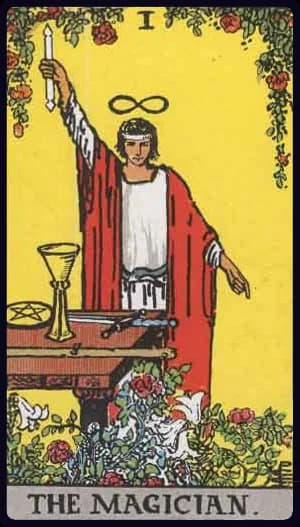
The Magician tarot card meaning starts with a number: card one, where things stop being potential and start being real. Yesterday the Fool was standing on a cliff with a bundle and a dream. Today someone is standing behind a table with every tool they need laid out in front of them, one hand raised to the sky and the other pointing at the ground. The message is pretty simple: you have what you need, so use it.
This is the second post in our series on the Major Arcana, one card a day. We'll go through where the Magician came from (spoiler: he started out as a street hustler), what every detail on the Rider-Waite-Smith card means, how to read it upright and reversed in love, work, money, health, and spiritual life, how it shifts by spread position, which cards change it, and the mistakes people make when it turns up.
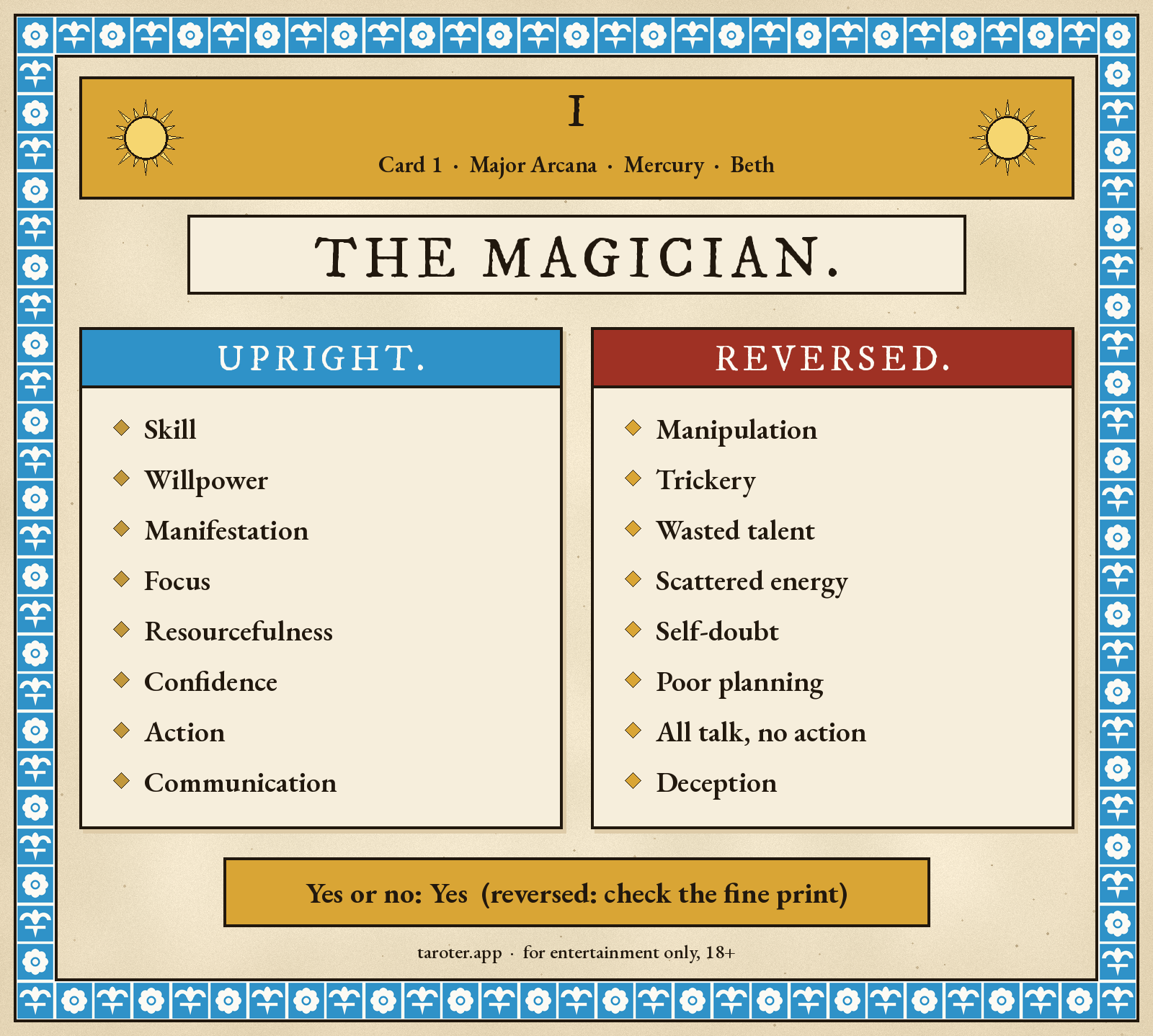
Quick reference
| Number | 1 |
| Arcana | Major |
| Element | Air (through Mercury) |
| Astrology | Mercury |
| Hebrew letter | Beth (ב) |
| Upright keywords | skill, willpower, manifestation, focus, resourcefulness, action, concentration |
| Reversed keywords | manipulation, trickery, wasted talent, scattered energy, self-doubt, all talk |
| Yes or no | Yes (reversed: check the fine print) |
Where the Magician comes from
The Magician didn't start out as a magician. In the early Italian decks he was il Bagatto or il Bagatella, and in the Tarot de Marseille he's Le Bateleur. Both names point to the same kind of person: a street performer, a juggler, a conjurer working a crowd at a fair. He stands behind a little table covered with cups, balls, dice, knives, and coins. If you've ever watched someone do the shell game on a sidewalk, you've met Le Bateleur.
So the original card carried a wink. This is a guy with fast hands who can make you see what he wants you to see. He's skilled, no question, but you might want to keep a hand on your wallet. In the Marseille version he often wears a wide-brimmed hat whose curving shape echoes the infinity sign that later ends up floating over his head.
By the 18th and 19th centuries, French occultists were reading tarot as a book of hidden wisdom, and the juggler got a promotion. He became the Magus, the adept, the person who understands how the seen and unseen worlds connect. When the Golden Dawn built its system in the late 1800s, card one became the Magician, the figure of trained will.
That's the version Arthur Edward Waite and Pamela Colman Smith put into the Rider-Waite-Smith deck in 1909. Smith dropped the crowd, the tricks and the dice, and painted a calm figure in a garden, robed like a priest, holding a wand up to the heavens. The table is still there, but now it holds the four suits of the Minor Arcana: a cup, a sword, a pentacle, and a wand. The hustler became the initiate.
In The Pictorial Key to the Tarot (1910), Waite describes the card as the divine motive in humanity, and gives upright meanings like skill, diplomacy, subtlety, self-confidence, and will. He also tosses in some odd ones that most modern readers ignore, like sickness and the snares of enemies. Reversed, he lists things like a physician, a magus, disgrace, and mental unease. Modern readings have settled on the clean version: upright is skill and willpower, reversed is skill turned crooked or wasted.
The older trickster never fully left, though. That's useful. When the Magician turns up, it's worth asking whether you're the one doing the magic or the one watching the cups get shuffled.
Why one?
One is the first real number. Zero (the Fool) is the empty circle. One is a single line, a point of focus, a decision. It's the "I" that says "I will." Where the Fool is open to everything, the Magician picks one thing and points all their energy at it. That's the jump from card zero to card one: from possibility to intention.
The symbolism, detail by detail
Smith's Magician is full of small, deliberate choices. Here's what's actually on the card.
One hand up, one hand down. The most famous detail. The Magician's right hand raises a wand toward the sky. The left hand points at the earth. This is the old occult idea of "as above, so below": the Magician draws energy or inspiration from above and grounds it in the physical world. In plain terms, they take an idea and make it real. They're the channel between the two.
The wand. It's white and double-ended, like a little baton with a tip at each end. Readers often see it as power flowing both ways, up and down, from spirit to matter and back again.
The infinity sign. A sideways figure eight, the lemniscate, floats above the Magician's head. It stands for endless energy, unlimited potential, and the idea that the Magician's power comes from something bigger than them. You'll see the same symbol again over the woman's head on the Strength card, card eight.
The table and the four tools. On the table lie the emblems of the four suits: a cup (Cups, water, emotion), a sword (Swords, air, thought), a pentacle (Pentacles, earth, money and the body), and a wand (Wands, fire, will and creativity). This is a big one. The Magician has every tool. Nothing is missing. Whatever the problem, the resources to handle it are already on the table.
The white robe and red cloak. The inner robe is white, for purity of intention. The outer cloak is red, for passion, action, and desire. Together they say the Magician acts with both a clear purpose and real drive. The Fool dressed for a party. The Magician dresses for work.
The serpent belt. Look at the Magician's waist. The belt is a snake swallowing its own tail, the ouroboros. It's an ancient symbol of eternity and cycles, and it echoes the infinity sign above. Power that renews itself.
The headband. A simple band holds back the Magician's hair. It's a small detail, but it reads as focus: no distractions, eyes on the work.
The roses and lilies. The Magician stands in a garden. Red roses hang overhead and grow around the top of the card, and white lilies grow in the foreground. Red roses are desire and passion. White lilies are purity and clear thought. The Fool carried a single white rose. The Magician is surrounded by both, as if the Fool's one small wish has grown into a whole garden of possibilities.
The yellow background. Like the Fool, the Magician stands against a bright yellow sky. Yellow is the color of the conscious mind, intellect, and daylight. Everything here is happening in full awareness. Nothing is hidden. (That changes tomorrow.)
Astrology, element, and the Hebrew letter
In the Golden Dawn system, the Magician is linked to the planet Mercury and the Hebrew letter Beth (ב).
Mercury is a perfect fit. In Roman myth he's the messenger of the gods, quick, clever, the god of communication, trade, travel, and, tellingly, thieves and tricksters. That's both sides of the Magician in one figure: the skilled communicator and the con artist. In astrology, Mercury rules the mind, speech, writing, and deals of every kind. When the Magician shows up, words and ideas tend to matter.
Mercury rules two signs, Gemini and Virgo, so people with strong Gemini or Virgo placements often feel a kinship with this card. Gemini gets the Magician's quick talk and multitasking. Virgo gets the Magician's craftsmanship and attention to detail.
Since Mercury is usually treated as an airy, mental planet, many readers give the Magician the element Air. Some also connect it to Fire because of the wand. Neither is wrong. The Golden Dawn itself gave this group of cards planets, and left elements out of it.
Beth is the second letter of the Hebrew alphabet, and the word means "house." It's also the first letter of the first word of the Hebrew Bible, Bereshit, "in the beginning." That works nicely: the Fool's Aleph is the silent breath, and Beth is the first sound that builds something, the first house, the first structure. On the Golden Dawn's Tree of Life, the Magician's path connects Kether (the crown, pure source) to Binah (understanding), carrying the first spark down into form.
Where the Magician sits in the Fool's Journey
The Fool starts with nothing but a bundle, a dog, and a lot of hope. The first person they meet on the road is the Magician, and the lesson is: you're not as empty-handed as you think.
Remember the Fool's staff? The Magician holds a wand too, but knows what to do with it. This is where the Fool learns that will and skill are real forces. Wanting something is only the start. You have to focus, pick up the tools, and act. The Fool's gift is the courage to begin. The Magician's gift is the ability to make something happen once you've begun.
Right after this, the Fool meets the High Priestess, card two, who teaches the opposite skill: stillness, listening, and knowing things you can't prove. The Magician is the conscious, active mind in full daylight. The High Priestess is everything happening under the surface. Most readers see them as a pair, and you need both. Power without intuition gets pushy. Intuition without action just sits there.
The Magician upright
Keywords: skill, willpower, manifestation, focus, resourcefulness, confidence, action, concentration, communication.
When the Magician comes up upright, it's one of the most encouraging cards you can get. It says you have the ability, the resources, and the energy to make something happen, and the time to use them is now.
The key word is focus. The Magician has four tools on the table and one wand pointed in one direction. In a reading, the card often shows up when you've been spreading yourself thin, waiting for more information, or telling yourself you need more time. The card says you're more ready than you think. Look at what's already on your table.
The upright Magician is also about turning ideas into reality. That's what people mean by "manifestation" in tarot, and it's more practical than it sounds online. It means you take something that exists only in your head (a plan, a business, a book, a conversation you need to have) and you do the actual steps to bring it into the world. As above, so below. Think it, then build it.
It's a strong card for communication too, thanks to Mercury. Pitches, interviews, negotiations, writing, presentations, sales, and the "can we talk" conversation all go better under the Magician. You're likely to find the right words.
And it's a card of confidence, the quiet kind that comes from knowing what you're doing. If you've been practicing, learning, and preparing, this is the moment it pays off.
The Magician reversed
Keywords: manipulation, trickery, deception, wasted potential, scattered focus, self-doubt, poor planning, all talk and no action.
Like the Fool, the reversed Magician tends to go one of two ways.
The Magician misusing the power
This is the old Bateleur coming back to the surface. Skill turned toward manipulation. Someone (maybe you, maybe someone around you) is using charm, clever talk, or a polished image to get something they haven't earned. The salesperson who's very persuasive and very vague. The partner who always has a great explanation. The "opportunity" that sounds amazing until you ask a basic question and the answer gets slippery.
If it's someone else, the reversed Magician is a warning to look behind the curtain. If it's you, it's a nudge to check your motives. Are you persuading, or are you pushing? Are you telling the truth, or a version of it that happens to get you what you want?
The Magician not using the power
The quieter and probably more common version. You have the tools on the table and you're not picking them up. Talent going to waste. Plans that never leave the notes app. A lot of planning and talking, very little doing. Or you've got so many ideas going at once that none of them gets your full attention, so none of them gets finished.
It can also be plain self-doubt: you have the skill, but you don't believe you do, so you hand the work to someone else or never start.
How to tell which one it is
Ask yourself one question: is there a gap between what's being said and what's being done? If someone's words don't match their actions, it's the manipulation side. If your own plans don't match your actions, it's the wasted-potential side. Either way, the reversed Magician points at the gap.
The Magician in love and relationships
Upright
If you're single: you're in a magnetic phase. People notice you. This is a good time to put yourself out there, start the conversation, send the message, show up at the thing. The Magician can also mean you're about to meet someone charming, confident, and quick with words. Enjoy the spark, just keep an eye on whether their actions back up the talk.
If you're in a relationship: the Magician is about taking action to make the relationship what you want it to be. Plan the date yourself. Have the honest conversation. Use your communication skills, because they're sharp right now. It can also point to a period where the two of you are building something together, like a home, a project, or a shared plan.
For feelings ("how do they feel about me?"): they're interested and they're thinking about how to make a move. There's attraction and intention here. They see you as someone worth pursuing.
Reversed
If you're single: be careful of people who are all charm and no substance. The reversed Magician is the classic smooth talker who says all the right things on the first date and disappears by the third. It can also mean you're presenting a version of yourself that isn't quite real, which makes it hard for anyone to connect with the actual you.
If you're in a relationship: there might be manipulation, game-playing, or a lack of honesty. Or it might just be poor communication: one person saying what they think the other wants to hear. It can also point to a relationship where the plans keep getting talked about and never get done.
For feelings: they may be interested in what you can do for them more than in you. Or they're unsure and putting on a show to hide it.
The Magician in career and work
Upright
This is one of the best career cards in the deck. It's a green light for launching a project, pitching an idea, starting a business, applying for the job, or asking for the raise. You have the skills and the timing is good. It's especially strong for work that involves communication, tech, sales, teaching, writing, design, or any craft where skill really shows.
The Magician also suggests you have all the resources you need, even if you don't think so. Before you go looking for more money, more training, or more help, take stock of what's already on your table. You might be surprised.
Reversed
Watch for office politics, a manager or client who promises more than they deliver, or a deal that looks too clean. On the personal side, the reversed Magician can point to burnout from trying to do too many things at once, or to talent you're not using because you're stuck in a job that doesn't ask for it. If you've been "about to" start your own thing for a while, this card wants to know what's actually stopping you.
The Magician in money and finances
Upright
A good time to take smart, active steps with money: start the side hustle, negotiate the salary, set up the budget, make the plan. The Magician rewards initiative. If you've been wondering whether you can turn a skill into income, the answer is likely yes.
Reversed
Be suspicious of get-rich-quick schemes, slick financial "gurus," and anything that sounds too good to be true. The reversed Magician is the con artist's card. It can also point to money lost through poor planning or scattered effort, like five side hustles that each earn twelve dollars.
The Magician in health and wellbeing
Tarot isn't a substitute for medical advice. If you have health concerns, see a professional.
Upright
You have more power over your wellbeing than you might think. The Magician is a good card for starting a new routine and actually sticking with it, because the card is all about focus and follow-through. It also points to the link between mind and body: your attitude and your habits are tools on the table, too.
Reversed
Scattered energy, burnout, or nervous tension. Too much going on in your head. The reversed Magician can also warn against miracle cures and anyone selling a health "secret" that sounds too easy.
The Magician in spirituality
In spiritual readings, the Magician is about realizing that you're an active player in your own life. It's the card of intention: setting a clear aim and putting your energy behind it, whether that's through meditation, ritual, prayer, or just deciding what you want and acting like you mean it.
The "as above, so below" pose is a reminder that spiritual life isn't separate from everyday life. What you believe should show up in what you do.
Reversed, it can mean you're treating spirituality like a performance, collecting tools and techniques without actually practicing. Or it can warn about a teacher or guru who seems a little too interested in your money or your loyalty.
The Magician by spread position
Past: a time when you took action and made something happen. You built a skill or a foundation that you're still drawing on now.
Present: you have everything you need, right now, to move forward. The question is whether you'll use it.
Future: read this as where your current path points: toward a chance to use your skills. Worth getting ready for.
Advice: focus. Pick one thing and give it your full attention. Use what you already have.
Obstacle or challenge: scattered energy, self-doubt, or someone being less than honest with you. Or you're overthinking when you should be doing.
Outcome: a reflection of what your own effort can do here. If the plan works, it's because you made it work.
Hopes and fears: you might hope you have what it takes and fear you don't. Both feelings usually mean you care enough to try.
The Magician as a yes or no
The Magician is a clear yes, especially for questions about taking action, starting something, or whether you can pull something off. You can. Go.
Reversed, it's closer to yes, but check the fine print. Make sure everyone's being honest, including you, and that the plan is real before you commit.
The Magician in combination with other cards
The Magician + The Fool: the courage to start plus the skill to finish. A great combination for any new venture.
The Magician + The High Priestess: action guided by intuition. You know what to do and how to do it. Trust your gut and then act on it.
The Magician + The Empress: creative power with real results. Great for artists, makers, parents, and anyone growing something from scratch.
The Magician + The Devil: a strong warning about manipulation, either being manipulated or being tempted to manipulate. Watch for power used to control.
The Magician + The Lovers: a smooth, confident approach to love. Or a choice about a relationship that you're fully able to make.
The Magician + The Moon: be careful. This pairing often points to illusion, trickery, or someone hiding the truth behind a clever act.
The Magician + The Wheel of Fortune: luck meets skill. Something you've been working toward lines up at the right time.
The Magician + Ace of Pentacles: a new income source or a business idea with real potential. Turn the skill into money.
The Magician + Eight of Pentacles: mastery through practice. Keep working at your craft, because it's paying off.
The Magician + Seven of Swords: deception and sneakiness. Someone isn't playing fair, and it could be clever enough to fool you if you don't look closely.
Common mistakes when reading the Magician
Reading it as literal magic. Thinking hard about what you want won't make the universe hand it over. The Magician says you have the ability to make it happen, and the work is the magic.
Forgetting about the trickster. Because the modern Magician looks so noble, people forget the card started as a con man. Upright, it's usually positive. But if something feels off in the situation, trust that feeling, especially if the cards around it are deceptive ones like the Moon or the Seven of Swords.
Ignoring the table. The four tools are the point. If you get the Magician and feel like you're missing something, the card is pushing back. Look again at what you already have.
Assuming it's always someone else. The Magician as "a charming man coming into your life" is a popular reading, and sometimes it's right. But more often, the Magician is you, and the card is asking you to step into your own power.
Treating reversed as "you can't do it." The reversed Magician points to ability that's blocked, misused, or untapped. That's fixable.
The Magician as a person
When the Magician represents someone in a reading, they're usually confident, smart, and good with words. They're the person who can walk into a room and get everyone on board with their idea. Often entrepreneurial, inventive, and skilled at something specific. They make things happen.
The shadow side is that they know how persuasive they are. The best version of a Magician uses that gift to help people. The worst version uses it to sell you something you don't need. In either case, they're hard to ignore.
Journal prompts for the Magician
- What's already on my table that I've been overlooking?
- If I had to pick one goal and give it all my focus for a month, what would it be?
- What have I been talking about for months without starting?
- What skill do I have that I undervalue?
- Is there anyone in my life whose words and actions don't line up? What about me?
- What would I attempt if I really believed I had what it takes?
Frequently asked questions
Is the Magician a good card? Yes, it's one of the most positive cards in the deck. It's about skill, focus, and the power to make things happen. Reversed, it warns about manipulation or wasted talent, but the ability is still there.
Does the Magician represent a man? No. Older decks show a man, and in readings the Magician can be anyone of any gender who has the card's confidence and skill. Very often it's you.
What does the Magician mean as feelings? Attraction with intention. They're interested and they're thinking about how to act on it. Reversed, the interest may be shallow, or they may be putting on an act.
What zodiac sign is the Magician? The Magician is ruled by Mercury, so it's connected to Gemini and Virgo, the two signs Mercury rules.
What does it mean if the Magician keeps showing up? You're being nudged to take action on something you've been planning or putting off. If it keeps showing up reversed, look at where your energy is leaking or where someone might not be straight with you.
What's the difference between the Magician and the Fool? The Fool is pure potential with no plan. The Magician is potential with a plan and the tools to carry it out. The Fool takes the first step. The Magician knows where the step is going.
Where the journey goes next
The Magician has the tools, the focus, and the will. But will only gets you so far. Next the Fool walks between two pillars into a quieter, darker room, where the High Priestess sits with a half-hidden scroll and teaches everything the Magician's bright daylight can't show: intuition, patience, and the things you know without being able to explain how. That's tomorrow's card.
If you missed it, start with yesterday's guide to the Fool, where the journey begins. And you can find the Magician's upright and reversed meanings at a glance on the Magician card page.
Taroter
Author
Related articles

The Hierophant Tarot Card Meaning: Tradition, Teachers, and What You Choose to Believe
The Hierophant is card five of the Major Arcana, and the Hierophant tarot card meaning starts with a reputation problem. People see a man...

The Emperor Tarot Card Meaning: Structure, Authority, and the Art of Holding Things Together
The Emperor is card four, and he is the least fun person at the party. He's also the reason there's a party at all: someone booked the...

The Empress Tarot Card Meaning: Abundance, Creativity, and the Art of Growing Things
The Empress is card three, and she's the first card in the Major Arcana that feels like you could lie down in it. The Magician worked under...