Justice Tarot Card Meaning: Truth, Fairness, and the Bill That Always Comes Due
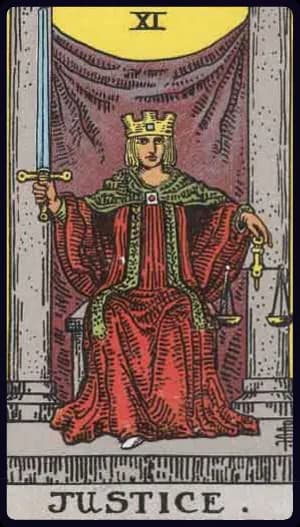
Justice is card eleven, and she's one of the most straightforward figures in the deck. She sits on a throne, looks you dead in the eye, and holds a sword in one hand and a set of scales in the other. There's no riddle here, no veiled hint. Justice is the card of truth, fairness, cause and effect, and owning what you've done.
That directness is exactly why people get nervous when she shows up. Most of us like the idea of fairness until we're the one being weighed. But Justice isn't out to punish anybody. She's interested in what's true and what's balanced, and in a lot of readings that's very good news: the honest effort pays off, the fair outcome arrives, the lie comes out.
This guide covers where the card came from, why it's card eleven in some decks and card eight in others (it's a real story), what each detail on the Rider-Waite-Smith card means, the astrology behind it, how to read it upright and reversed in every area of life, how it changes by spread position, the cards that shift its meaning, and the mistakes people make with it.
Quick reference
| Number | 11 (XI); 8 in the Tarot de Marseille and many older decks |
| Arcana | Major |
| Element | Air |
| Astrology | Libra |
| Hebrew letter | Lamed (ל) |
| Upright keywords | fairness, truth, cause and effect, accountability, balance, clear decisions, law |
| Reversed keywords | unfairness, dishonesty, avoiding responsibility, bias, legal trouble, imbalance |
| Yes or no | Yes if you've acted fairly (reversed: no, or not on these terms) |
Where Justice comes from
Justice is one of the oldest ideas in the trumps. Early Italian tarot decks in the 15th century included a set of virtues that every educated person of the time would have recognized: Justice, Strength (also called Fortitude), and Temperance. These came from the four "cardinal virtues" of ancient Greek and Christian thought. The fourth, Prudence, is oddly missing from the tarot, and people have argued for centuries about whether some other card (the Hermit, maybe, or the World) quietly stands in for her.
The image of Justice as a woman with a sword and scales was already everywhere by then. You'd see her carved on town halls and courthouses and painted in churches. She goes back to the Greek goddess Themis and her daughter Dike, and to the Roman Justitia. The scales stood for weighing evidence fairly. The sword stood for the power to act on the verdict. One without the other doesn't work: weighing with no power to act is just an opinion, and power with no weighing is just force.
In the Tarot de Marseille, La Justice is a crowned woman sitting on a throne, holding the sword upright and the scales out to one side. She's solid and formal, a bit stiff. She looks like she's been sitting there a long time and plans to sit there a lot longer.
Why Justice is 11 in one deck and 8 in another
Here's the part that confuses people. In the Tarot de Marseille, Justice is card eight and Strength is card eleven. In the Rider-Waite-Smith deck, it's the other way around: Strength is eight, Justice is eleven.
The swap comes from the Hermetic Order of the Golden Dawn, the 19th-century occult group that Arthur Edward Waite belonged to. The Golden Dawn linked each trump to a Hebrew letter and an astrological sign or planet. When they laid out the cards in order, they found that Justice ended up with Leo and Strength with Libra, which made no sense. A card with a woman taming a lion should obviously be Leo. Their fix was to switch the two cards so that Strength (Leo) came before Justice (Libra), matching the order of the zodiac and keeping the Hebrew letters in sequence.
Waite used that order when he and artist Pamela Colman Smith made the Rider-Waite-Smith deck in 1909. In The Pictorial Key to the Tarot (1910), he mentions the change only briefly. He says, more or less, that he had his own good reasons for it and the reader doesn't need to worry about them. Very Waite.
Today, both orders are in use. Most decks based on the Rider-Waite-Smith put Justice at eleven. Marseille-style decks, and some others like Aleister Crowley's Thoth deck (where the card is renamed "Adjustment"), keep it at eight. If your deck says VIII, nothing's wrong with it. The meaning is the same either way.
What Waite said it meant
Waite's upright meanings for Justice are what you'd expect: fairness, rightness, honesty, and the deserving side winning in a legal matter. His reversed meanings are interesting. He lists the law in general, legal complications, bias, bigotry, and too much severity. In other words, reversed Justice can mean injustice in the sense of "the bad guys win," and it can mean justice gone wrong: rules applied too harshly, bias passing itself off as fairness, and red tape.
The symbolism, detail by detail
The figure on the throne. Justice sits upright on a stone throne, facing straight ahead. She's still and calm. She isn't rushing anything. Her posture says this decision will take as long as it needs to take.
Her eyes are open. Unlike the Lady Justice statues on courthouses, the tarot Justice usually isn't blindfolded, and on the Rider-Waite-Smith card she looks straight at you. That's a big difference. The blindfolded statue says "justice doesn't care who you are." The tarot version says "justice sees exactly who you are." You can't hide anything from her, including the parts you'd rather not look at.
The sword. Held straight up in her right hand. It's double-edged, which readers often take to mean that a fair decision can cut both ways: it can free you and it can cost you. The sword is also the tool of clear thinking in tarot (it's the symbol of the Swords suit, which is about the mind). Justice cuts through confusion to get to the point.
The scales. Held in her left hand, balanced and level. Weighing, considering, looking at both sides. The scales are a reminder that real fairness takes patience. You have to actually look at the evidence before you swing the sword.
The crown. She wears a crown with a small square jewel in the middle. The square is a shape of order and structure, and it's often read as clear, organized thought. The crown says she has authority. Her verdicts aren't suggestions.
The red robe and green cloak. Red is action and life. Green is growth and, in some readings, compassion. Together they suggest a kind of justice that's active and alive. The cloak is fastened at the chest with a square clasp, echoing the jewel in her crown.
The two pillars. Justice sits between two grey stone pillars. If you've already met the High Priestess, card two, you'll remember she also sits between pillars, but hers are black and white and stand for opposites. Justice's pillars are both grey. Here, there's a balance to be found between the sides.
The purple veil. Hanging between the pillars behind her is a purple curtain. Purple is the color of wisdom and, traditionally, royalty. The veil hides whatever's behind it, which some readers link to the High Priestess's veil of hidden knowledge. Justice works with what's in front of her: the facts, the evidence, the truth of the matter. What's behind the curtain is a different card's business.
The gold background. Above the veil, the sky is yellow-gold. Yellow often stands for intellect and clarity in Smith's art. Justice is a thinking card, a card of clear light.
The white shoe. Look at the bottom of the card. Peeking out from under her robe is one white shoe, as if she's about to step forward. It's a small detail that readers love. Justice sits and weighs, and when the decision's made, she acts on it. The white color is often read as purity of intention.
Astrology, element, and the Hebrew letter
The Golden Dawn gave Justice the zodiac sign Libra and the Hebrew letter Lamed (ל). This is what caused the whole Strength-Justice swap: Libra belongs after Leo in the zodiac, so Justice had to come after Strength.
Libra is the sign of the scales, which makes this one of the easiest attributions in the deck to remember. Libra is about balance, fairness, partnership, and weighing one thing against another. It's an Air sign, so the card's element is Air: thought, communication, and reason. Libra is ruled by Venus, which adds a softer note. Fairness in Libra's sense is also about harmony, and about relationships that feel even.
Lamed means "ox-goad," the long pointed stick farmers used to keep oxen moving in a straight line. That's a lovely image for Justice. She's not about a single dramatic punishment so much as steady correction: the nudge that keeps you on the path. Lamed is also the tallest letter in the Hebrew alphabet and sits close to its middle, which fits a card that stands upright at the center of things and holds them in balance.
If you're a Libra or have a lot of Libra in your chart, you might find Justice turns up a lot, and that you have strong feelings about fairness. You probably already knew that.
Where Justice sits in the Fool's Journey
The Fool has just been spun around by the Wheel of Fortune, card ten. The Wheel's lesson was that some things are bigger than you: luck, timing, fate. It's humbling, and it can be a little scary. If everything is chance, why bother trying to be good?
Justice is the answer. The Fool learns that a lot of what happens to you is the result of what you've done. Choices have consequences. Honest work tends to pay off over time. Lies tend to come out. The universe keeps some kind of books, even if they don't balance as fast as you'd like.
That's why Justice comes right after the Wheel. The two cards are a pair. The Wheel is what happens to you. Justice is what happens because of you. Mature people learn to tell the two apart, and to take responsibility for their part without blaming themselves for all of it.
Justice also asks the Fool to be honest with themselves, maybe for the first time. The Hermit taught them to look inward. Justice asks them to look inward and actually tell the truth about what they see. That honesty sets up the next card, the Hanged Man, card twelve, where the Fool stops trying to control the outcome entirely, hangs upside down, and sees the whole thing from a completely new angle.
Justice upright
Keywords: fairness, truth, accountability, cause and effect, balance, honesty, clear decisions, legal matters, integrity.
When Justice shows up upright, the truth of the situation is going to matter. That's good news if you've been honest and fair, and less comfortable news if you haven't. Either way, Justice says the outcome will reflect what actually happened.
The upright card often points to a decision that needs to be made with a clear head, free of fear, people-pleasing, and anger. Weigh it up properly. Look at the facts. Then decide and stand behind it. Justice is very good at helping you see what the right choice is. She's less interested in whether it's the easy one.
It's a card of accountability. If you've made a mistake, own it. If someone else has, it's fair to hold them to it. Justice doesn't like blame games, and she doesn't like martyrdom either. She just wants the record to be accurate.
It's also a card of cause and effect. What you've been putting in is what you'll get out. If you've been working hard, studying, saving, treating people well, the results are coming. If you've been cutting corners, Justice says that's going to show.
And in practical terms, upright Justice often shows up around legal matters, contracts, and official decisions: court cases, custody, divorce settlements, insurance claims, visa applications, signing anything important. Upright, it generally means the fair result. That's not always the result you want. But it's the one that matches the facts.
Justice reversed
Keywords: unfairness, dishonesty, avoiding responsibility, bias, self-deception, legal setbacks, imbalance, being too harsh.
Reversed, Justice can go a couple of very different directions.
Unfairness from outside
The plain reading: something isn't fair. A decision goes against you that shouldn't have. Someone lies and gets away with it, for now. A process is rigged, biased, or slow. You're being judged on something that isn't the truth.
This reading is real and it's frustrating. The reversed card doesn't ask you to pretend it's fine. It asks you to keep your own record straight, gather your evidence, and push for the truth to come out. And it reminds you, gently, that the scales do tend to level out eventually, even if "eventually" is not the timeline you'd choose.
Dodging your own part
The more uncomfortable reading, and the one that shows up a lot: you're not being fully honest with yourself about your share of the situation. Maybe you're blaming everybody else. Maybe you're telling a version of the story where you look a bit better than you should. Maybe you know you owe someone an apology and keep putting it off.
None of this makes you a bad person. You just can't fix what you won't look at. The moment you own your part, the situation usually gets lighter.
Justice gone wrong
There's also Waite's version: too much severity, bias, rules applied without mercy. Sometimes reversed Justice is about being far too hard on someone, including yourself. You keep punishing yourself for an old mistake long after you've paid for it. Or you're holding someone to a standard that isn't fair. The scales are tipped, just in the other direction.
How to tell which one it is
Ask yourself honestly: when you saw this card, did you think of someone else, or did you flinch? If your mind went straight to someone who wronged you, it may be the first reading. If you felt a little caught, it's probably the second. And if you felt a heavy, tired kind of guilt about something old, it might be the third: the scales want you to let it go.
Justice in love and relationships
Upright
If you're single: you're ready for a relationship that's balanced and honest. Justice can bring someone fair-minded and grown-up into your life. It's also a good time to get clear on what you want and what you won't accept. Your standards are not too high if they're fair.
If you're in a relationship: honest conversations, fair compromises, and evening things out. If one person has been doing more of the emotional or practical work, Justice says it's time to rebalance. It can also point to commitments being made official: marriage, moving in, joint accounts, signing a lease together. And if there's been something unsaid, Justice says it's time to say it.
For feelings ("how do they feel about me?"): they respect you and see you clearly. Their feelings may be more thoughtful than giddy. They're weighing things, thinking about whether this is fair and right, and taking it seriously.
Reversed
If you're single: you might be repeating an unfair pattern, like giving far more than you get or picking people who don't treat you as an equal. Or you're judging potential partners too harshly to let anyone in.
If you're in a relationship: an imbalance that isn't being addressed. Someone is being dishonest, taking more than they give, or refusing to own their part in a conflict. It can also point to a breakup where things aren't being split fairly, or to arguments that are really about keeping score.
For feelings: they may feel the relationship is unfair, or they may be avoiding honesty about how they feel. There could be guilt in there too.
Justice in career and work
Upright
Fair treatment at work, and the results of your effort finally showing up. A promotion or raise you've earned, a fair performance review, a contract that works for both sides. Justice is good for anything involving negotiations, HR, legal work, or official paperwork. It's also a good card for careers in law, mediation, policy, compliance, or anything where fairness and accuracy are the job.
If you're facing a work decision, Justice says to weigh it properly and pick the option you can stand behind long-term.
Reversed
Unfair treatment at work: being passed over, office politics, someone taking credit for your work, a biased boss. It can also point to dishonesty in a workplace, or to you cutting corners in a way that'll catch up with you. If there's a dispute, document everything.
Justice in money and finances
Upright
Money matters get settled fairly. A debt is repaid, a refund comes through, a settlement goes your way, taxes get sorted. Justice is also a good card for getting your financial house in order: budgets, paperwork, reading the contract before you sign it. What you've put in is what you get out.
Reversed
Unfair financial dealings, a contract that's not in your favor, or money disputes. Be careful with fine print, loans, and anyone who seems to be keeping something from you. It can also point to avoiding a financial responsibility you know you need to face.
Justice in health and wellbeing
Tarot isn't a substitute for medical advice. If you have health concerns, see a professional.
Upright
Balance. Justice asks whether your habits are in proportion: work and rest, effort and recovery, what you eat and how you move. It's also a cause-and-effect card, so the healthy habits you've been building are likely to start paying off. In some readings, it points to getting a clear, accurate answer about a health question.
Reversed
Something's out of balance, or you're ignoring the consequences of a habit you know isn't working for you. It can also point to being too hard on yourself about your health. Fairness applies to how you treat your own body too.
Justice in spirituality
Spiritually, Justice is about karma in its simplest sense: actions have results. It's also about integrity, which originally means "wholeness." The more your inner life and your outer actions line up, the lighter you feel.
Upright, Justice can mean a time of spiritual honesty: looking at your values and asking whether you're actually living by them. It's a good card for making amends, settling old debts (emotional or otherwise), and choosing to act from your principles.
Reversed, it can mean spiritual hypocrisy (saying one thing, doing another) or carrying a load of guilt that's out of proportion to what you did. The scales should be level.
Justice by spread position
Past: a decision or consequence that shaped where you are now. Something was settled, fairly or not, and you're living with the result.
Present: a time to be honest, weigh things up, and make a clear choice. Something is being decided, or needs to be.
Future: a fair result is on its way. What you've put into this situation will come back to you.
Advice: tell the truth, including to yourself. Look at the facts, own your part, and decide based on what's right.
Obstacle or challenge: unfairness, bias, or dishonesty in the situation. Or your own reluctance to face your part in it.
Outcome: the situation resolves fairly and according to the truth. Upright, that usually means the deserving side wins.
Hopes and fears: you may want a fair result and be afraid of what fairness will actually show. That's very human.
Justice as a yes or no
Justice is a yes, with a condition: it's a yes if you've been fair and honest, and if what you're asking for is actually deserved. It's the yes of "you've earned it."
Reversed, it leans no, or "not on these terms." Something about the situation isn't fair or isn't honest yet. Fix that, and the answer may change.
Justice in combination with other cards
Justice + Wheel of Fortune: karma in action. A cycle closes with a fair result. What went around comes around.
Justice + The Hanged Man: a decision that needs a pause. Don't rush the verdict. Look at it from another angle first.
Justice + Judgement: a big reckoning. A final decision, a clear verdict, or a moment where everything comes to light at once.
Justice + The Emperor: law, authority, and official structures. Courts, government, contracts, and the people who enforce the rules.
Justice + The Lovers: a relationship decision made with your head as well as your heart. Or a partnership becoming legally official.
Justice + The Devil: an unfair agreement, a bad contract, or a situation where someone is being exploited. Read the fine print.
Justice + Two of Swords: a decision you're avoiding. You know you have to weigh it up and choose, but you keep putting it off.
Justice + Seven of Swords: dishonesty is being exposed. Someone's been getting away with something, and the truth is catching up with them.
Justice + Six of Pentacles: fair exchange. A balanced give-and-take, money owed being repaid, or fair pay for your work.
Justice + Queen of Swords: clear, honest judgment. A person who tells it like it is, or advice to see the situation without sentiment.
Justice + Three of Swords: a painful truth that needs to be faced. The hurt is real, but honesty is how it starts to heal.
Justice + Ten of Wands: taking on more than your fair share. Something needs to be rebalanced.
Common mistakes when reading Justice
Reading it as punishment. Justice is about fairness. For most people asking most questions, the upright card is good news.
Assuming fair means "what I want." Justice gives you the result that matches the truth, which is not always the result you were hoping for. Sometimes the fair outcome is a no.
Only reading it about other people. When Justice shows up, it's tempting to think of everyone who's wronged you. Check your own side of the scale first.
Ignoring the practical side. Justice is one of the few Major Arcana cards that often points to something concrete: a contract, a court date, a form, an official decision. If you've got paperwork pending, the card might be talking about exactly that.
Forgetting about mercy. Justice is balance, and balance includes compassion. If you've been punishing yourself or someone else far beyond what's fair, that's also out of balance.
Justice as a person
When Justice represents someone, it's usually a fair-minded, honest, and principled person. They tell the truth even when it's uncomfortable, and they can't stand hypocrisy. They're good at seeing both sides and making a clear call. Think lawyers, judges, mediators, teachers, and that one friend everyone goes to when they need an honest opinion.
At their best, they're trustworthy, balanced, and wise. At their worst, they can be rigid, judgmental, or so focused on the rules that they forget the people. Reversed, it can point to someone who claims to be fair but plays favorites, or someone who avoids responsibility.
Journal prompts for Justice
- Where in my life am I not being fully honest, even with myself?
- Is there a decision I'm putting off because I already know the answer?
- What's my part in a situation I've been blaming on someone else?
- Where am I giving more than I'm getting? Where am I taking more than I give?
- Is there an old mistake I'm still punishing myself for? What would fair look like now?
- What do I actually value, and does my week reflect it?
Frequently asked questions
Is Justice a good or bad card? Mostly good. It means fairness, truth, and getting what you've earned. It can feel uncomfortable if you haven't been honest, but it's not a punishment card.
Why is Justice card 11 in some decks and 8 in others? The Golden Dawn swapped Justice and Strength to line up with their astrology and Hebrew letter system (Strength with Leo, then Justice with Libra). Waite used that order in the Rider-Waite-Smith deck. Older decks like the Tarot de Marseille keep Justice at 8. The meaning is the same.
What does Justice mean as feelings? Respect, honesty, and serious consideration. They see you clearly and are weighing whether the relationship is balanced and right.
What zodiac sign is Justice? Libra, the sign of the scales.
Does Justice mean I'll win my court case? Upright, it generally points to a fair result, and the deserving side winning. That's a good sign if the facts are on your side. Reversed, it suggests delays, complications, or bias, so get good advice and be thorough.
Does Justice mean karma? In the loose, everyday sense, yes. Actions have consequences, and Justice says they're coming due.
Where the journey goes next
After the Wheel of Fortune taught the Fool that some things are out of their hands, Justice taught them which things aren't. If you missed it, you can read yesterday's Wheel of Fortune guide for the other half of the pair.
Next up is the Hanged Man, card twelve, where the Fool stops trying to win, hangs upside down from a tree, and finds out how different the world looks from there. That's tomorrow's card.
Until then, you can see Justice's upright and reversed meanings and how it shows up in readings on the Justice card page. Or draw a card in Taroter and see what the scales have to say.
Ara Mckee
Writer
Related articles
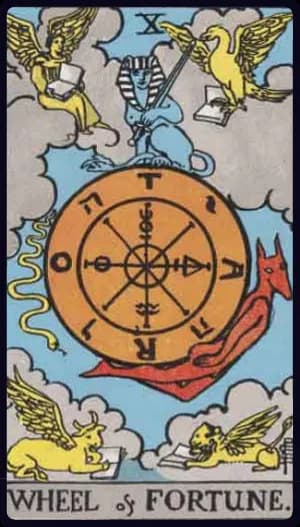
Wheel of Fortune Tarot Card Meaning: Luck, Cycles, and the Turn You Can't Stop
The Wheel of Fortune is card ten, and it's the first Major Arcana card with no person standing in the middle of it. The Magician has a...
1.8K40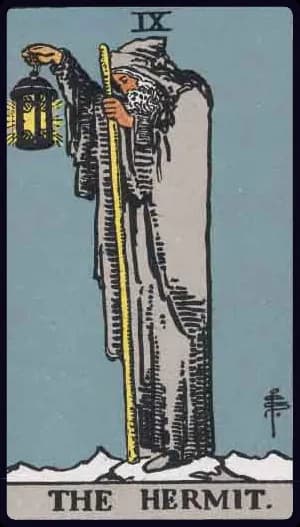
The Hermit Tarot Card Meaning: Solitude, Soul-Searching, and the Light You Carry
The Hermit tarot card meaning starts with silence. It's card nine, the quietest card in the Major Arcana. An old man in a gray cloak stands...
1.9K55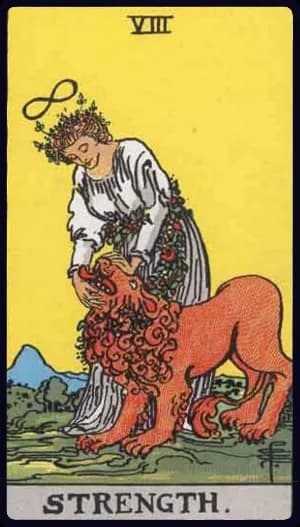
Strength Tarot Card Meaning: Courage, Patience, and the Gentle Kind of Power
Strength is card eight, and it shows one of the calmest scenes in the whole deck. A woman in a white dress has her hands on a lion's jaws,...
1175