The Hermit Tarot Card Meaning: Solitude, Soul-Searching, and the Light You Carry
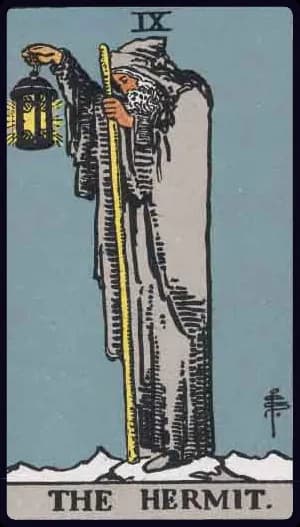
The Hermit tarot card meaning starts with silence. It's card nine, the quietest card in the Major Arcana. An old man in a gray cloak stands alone on a snowy peak at night, holding up a lantern. There's no crowd, no landscape to speak of, no action. Just one person, one light, and a lot of empty dark around them.
People sometimes flinch when they draw it, because it looks lonely. And sometimes it is. But the Hermit is no punishment and no bad omen. It marks the part of the journey where you step away from the noise to figure out what you actually think, what you actually want, and what you actually believe. Most people need that more often than they get it.
This guide covers where the Hermit came from, what every detail on the Rider-Waite-Smith card means, its astrology, how to read it upright and reversed in every area of life, how spread position changes it, which cards change its meaning, and the mistakes people make when it shows up.
Quick reference
| Number | 9 (IX) |
| Arcana | Major |
| Element | Earth |
| Astrology | Virgo |
| Hebrew letter | Yod (י) |
| Upright keywords | solitude, introspection, inner guidance, wisdom, soul-searching, rest, mentorship |
| Reversed keywords | isolation, loneliness, withdrawal, avoidance, being lost, refusing help |
| Yes or no | Maybe (leans no, or not yet) |

Where the Hermit comes from
In the earliest Italian tarot decks of the 15th century, this card often wasn't a hermit at all. It was an old man holding an hourglass, and it was frequently called Il Gobbo, "the hunchback," or simply the Old Man. He stood for Time: the figure we'd now call Father Time, who comes for everyone and wears everything down. In the parade logic of the early trumps, Time was a force that triumphed over earthly things like love, fame, and power.
Somewhere along the way, the hourglass turned into a lantern. Nobody knows exactly when or why. One common theory is that artists copying older designs misread the shape. Another is that the meaning simply shifted from time passing to wisdom gained over time. Either way, by the Tarot de Marseille, the card is called L'Hermite and shows a cloaked old man with a staff and a lantern. In many Marseille decks, he holds the lantern half hidden under his cloak, as if he's keeping the light close.
When Arthur Edward Waite and Pamela Colman Smith made the Rider-Waite-Smith deck in 1909, they put the Hermit on a mountaintop and held his lantern up high. That small change does a lot. The Marseille Hermit looks like he's searching. Smith's Hermit looks like he's already found something, and he's holding it up so others can see.
Waite makes exactly that point in The Pictorial Key to the Tarot (1910). He says the card has often been read as the ancient philosopher Diogenes, who supposedly wandered Athens with a lamp looking for an honest man. Waite disagrees. In his reading, the Hermit has already found what he went looking for. He has reached the heights and is lighting the way for others: a message that says, roughly, where I am, you can be too.
Waite's divinatory meanings are a little surprising. For the upright card he lists prudence and caution, but also treason, deceit, and corruption. For reversed he lists concealment, disguise, fear, and caution taken too far. Modern readers have mostly dropped the darker upright meanings and kept the reversed idea of fear and withdrawal. The Hermit today is overwhelmingly read as a card of wisdom, introspection, and inner guidance.
Where this card sits in the Fool's Journey
In the Chariot, the Fool learned to win in the outside world through willpower. In Strength, they learned a deeper power: calming the lion inside them with patience and compassion. Both of those cards are about mastering forces. By now, the Fool has achieved a lot. They have skill, knowledge, love, drive, and self-control.
But they haven't yet asked the big questions. Who am I when no one's watching? What do I actually believe, apart from what I was taught? What is all this for?
The Hermit is where the Fool steps away from everything to find out. It's the first real turn inward on the journey. Everything up to now has been about learning from others and acting in the world. The Hermit is about learning from yourself. It takes solitude, quiet, and time, which is why it's such a natural next step after Strength. You can't sit alone with yourself comfortably until you've made some peace with the lion.
The Hermit also marks the end of the first big section of the Major Arcana. After this comes the Wheel of Fortune, card ten, where the Fool comes down from the mountain and runs straight into forces bigger than any of them: luck, fate, timing, and change. The Hermit is the last quiet moment before the wheel starts turning.
The symbolism, detail by detail
The Hermit is a sparse card, so every detail stands out.
The old man. The Hermit is old, with a long white beard. Age here means experience and wisdom, the kind you only get by living through things. He's a figure who has done the climbing and the learning already.
The lantern. He holds a lantern up in his right hand. It's his inner light: wisdom, truth, insight. It doesn't light up the whole mountain. It lights just enough to see the next step. That's an honest picture of how self-knowledge works. You rarely get to see the whole path. You get enough light for where you're standing.
The six-pointed star. Inside the lantern is a six-pointed star, sometimes called the Seal of Solomon. It's made of two triangles, one pointing up and one pointing down, which is often read as the joining of heaven and earth, or spirit and matter. The light the Hermit carries is both practical and spiritual.
The staff. In his left hand he holds a long wooden staff. It's support for the climb and a sign of authority, like a teacher's or elder's staff. It also links him to the Fool, who carried a stick of his own. The Fool's stick held a bundle for the trip. The Hermit's staff is what's left after a long journey: plain, sturdy, and useful.
The gray cloak and hood. He's wrapped in a heavy gray cloak with the hood up. Gray is the color between black and white, the color of neutrality and quiet. It helps him blend into the background. The hood suggests withdrawal from the world and turning attention inward.
The downcast eyes. He's looking down. His attention is inward, or on the path right in front of him. This is a man lost in thought, with nobody to perform for.
The snowy peak. He stands on top of a mountain covered in snow and ice. He has climbed to the top, which means he's reached some kind of height: of wisdom, of spiritual attainment, of solitude. Snow is cold and isolating, but it's also clean and still. Up here, nothing distracts him.
The dark sky. The sky behind him is a dark grayish blue, either night or a cold, overcast dusk. That darkness is why the lantern matters. The Hermit's journey happens in the dark: in confusion, in uncertainty, in the parts of life where nobody can tell you the answer.
Which way he faces. On the Rider-Waite-Smith card, the Hermit faces toward the left side of the card. Some readers connect left with the past and with reflection, as if he's looking back over the road he's traveled. It's a minor detail, but it fits the card's mood of looking back and taking stock.
Astrology, element, and the Hebrew letter
The Golden Dawn linked the Hermit to Virgo, the Hebrew letter Yod (י), and so to the element of Earth.
Virgo might seem like an odd pairing for a mystic on a mountain. Virgo is usually associated with practicality, analysis, health, service, and getting the details right. But think about what the Hermit is doing: careful, patient, solitary work. Sorting through his own thoughts. Refining what he knows until only the truth is left. That's very Virgo. Virgo is also traditionally the sign of the Virgin, which connects to purity and self-containment, a person complete in themselves. And Virgo is ruled by Mercury, the planet of the mind, which fits the Hermit's thoughtful nature.
Earth fits too. For all his spirituality, the Hermit's wisdom is grounded. He stands on solid rock. His lantern lights a real path. The insights the Hermit offers are meant to be used in everyday life.
Yod is the smallest letter in the Hebrew alphabet, shaped a bit like a flame or a small tongue of fire. Its name means "hand." In Kabbalistic tradition, it's said to be the starting point of all the other letters, the seed from which they're formed. That fits the Hermit nicely: a small point of light, carried in a hand, that contains a whole world of meaning.
If you're a Virgo, or have strong Virgo or Earth placements, the Hermit may feel like home: quiet, thoughtful, careful, and happiest with time alone to think.
The Hermit upright
Keywords: solitude, introspection, soul-searching, inner guidance, wisdom, contemplation, retreat, rest, mentorship.
When the Hermit shows up upright, it's time to step back. Something in your life calls for reflection before action. You might need time alone, a break from social obligations, or simply some quiet to hear yourself think.
This card often appears when you've been very busy or very outward-focused, and you've lost touch with what you want. It's an invitation to slow down and look inward. What do you really think about the decision you're facing? What would you choose if nobody else's opinion mattered? Those questions are hard to answer in a crowd.
The upright Hermit is also about inner guidance. You don't need someone else to tell you the answer. You already have a lantern. The card suggests trusting your own judgment, intuition, and experience.
It can be a card of rest, too. The real kind: giving yourself permission to withdraw for a while. Burnout, grief, heartbreak, big life changes: these often need a Hermit phase, when you pull back to recover and understand what happened.
And sometimes the Hermit is about mentorship. Either you're being guided by a wise teacher, counselor, or elder, or you're the one holding the lantern for someone else. The Hermit on the Rider-Waite-Smith card holds his light up high for others to follow.
The Hermit reversed
Keywords: isolation, loneliness, withdrawal, avoidance, feeling lost, refusing help, too much solitude, or not enough.
Reversed, the Hermit's solitude goes wrong. There are two ways that tends to happen.
Too much Hermit
You've withdrawn so far that it's not healthy anymore. Solitude has turned into isolation. You might be avoiding people, cutting yourself off, or hiding from life and calling it reflection. Sometimes this looks like loneliness. Sometimes it looks like being stuck in your own head, overthinking everything and never coming back down the mountain.
This is the version Waite was pointing at with words like fear, concealment, and caution taken too far. The cave has become a hiding place.
Not enough Hermit
The opposite. You badly need time alone and you're not taking it. You keep filling every quiet moment with noise, plans, people, or screens, because sitting with yourself feels uncomfortable. You're avoiding the inner work the Hermit is asking for. You might also be ignoring your own inner guidance and looking for answers from everyone except yourself.
How to tell which one it is
Ask: have I been hiding, or have I been running? If you've been withdrawn, lonely, or stuck, it's too much Hermit, and it's time to come back to the world. If you've been busy, scattered, and avoiding your own thoughts, it's not enough Hermit, and you need to make some space for quiet.
Either way, the reversed Hermit is asking for balance. Solitude is a tool. It's meant to help you come back clearer and then get back to the rest of your life.
The Hermit in love and relationships
Upright
If you're single: this might be a time to put your energy into yourself for a while. That's not a bad thing. The Hermit suggests getting clear on who you are and what you really want before you look for a partner. If you do meet someone, it might be through quiet, meaningful places: a class, a retreat, a bookstore, a long walk. It can also point to an older or more introspective partner.
If you're in a relationship: one or both of you may need some space, the "I need time to think" kind. Healthy relationships have room for each person to have their own inner life. The Hermit can also show a relationship that's deep, quiet and drama-free, built on long conversations and shared reflection.
For feelings ("how do they feel about me?"): they're thinking about you seriously, but quietly. They may be reflective, cautious, or unsure how to express what they feel. They usually process things on their own, and the distance is rarely personal.
Reversed
If you're single: loneliness. You might feel cut off from love, or you've isolated yourself so long that dating feels impossible. It can also mean you're avoiding dealing with past heartbreak by hiding from new connections.
If you're in a relationship: emotional distance. One partner may be withdrawing, shutting down, or refusing to talk. The relationship may feel lonely even though you're together. On the other side, it can mean someone is so afraid of being alone that they've lost themselves in the relationship.
For feelings: they might be emotionally unavailable, withdrawn, or too wrapped up in their own issues to show up for you right now.
The Hermit in career and work
Upright
A time to reflect on your career before you charge ahead. Are you on the right path? Does your work match what you actually value? The Hermit is a good card for career soul-searching, especially if you've been feeling restless or empty at work.
It can also point to work that's solitary, thoughtful, or specialized: research, writing, study, counseling, teaching, or any job where deep focus matters more than networking. And it can show a mentor, someone experienced who can guide you, or a time when you're becoming that mentor for others.
Reversed
Feeling isolated at work, or disconnected from what you do. You might be withdrawing from your team, or you've lost your sense of purpose and don't know where to find it again. It can also mean you're so focused on your own work that you've stopped collaborating. Reach out. You don't have to figure it all out alone.
The Hermit in money and finances
Upright
A thoughtful, careful approach to money. The Hermit is a good card for reviewing your finances, getting clear on what you really need, and cutting back on things that don't matter to you. It can also suggest that what you value is shifting away from material things. Simplicity and enough are the Hermit's financial watchwords.
Reversed
Being too cautious with money, to the point of fear. Or avoiding looking at your finances because it feels overwhelming. It can also point to financial isolation, like not asking for help when you need it. Get advice from someone you trust.
The Hermit in health and wellbeing
Tarot isn't a substitute for medical advice. If you have health concerns, see a professional.
Upright
Rest and recovery. The Hermit suggests your body or mind needs quiet time to heal. It's a good card for slowing down, getting more sleep, and spending time away from stress. It can also point to mental health and the value of reflection, therapy, or meditation.
Reversed
Isolation affecting your wellbeing, or ignoring what your body is telling you. It can also suggest loneliness weighing on your mental health. If you've been withdrawing, think about reconnecting with people who care about you, and with professional support if you need it.
The Hermit in spirituality
The Hermit is one of the most deeply spiritual cards in the deck. It's the seeker, the monk, the pilgrim. Upright, it suggests a period of spiritual retreat, study, or meditation. You're looking for truth, and the best place to find it is inside yourself. It can also point to a spiritual teacher or guide entering your life.
The lantern is a reminder that you already have a light. You don't have to borrow someone else's. Reversed, the Hermit can mean you're disconnected from your inner wisdom, or you've become so focused on spiritual withdrawal that you've lost touch with everyday life. The Hermit eventually comes down the mountain. Wisdom is meant to be shared.
The Hermit by spread position
Past: a period of solitude, reflection, or retreat that shaped who you are now. Or a mentor who guided you.
Present: you need time to think. Step back from the noise and listen to yourself.
Future: a quieter, more reflective chapter is coming. It'll bring clarity, even if it's lonely for a while.
Advice: take time alone. Trust your own wisdom. Don't make big decisions until you've had a chance to really think.
Obstacle or challenge: too much isolation, or avoiding the inner work you need to do. You might be cutting yourself off, or refusing to sit with yourself at all.
Outcome: clarity and wisdom, gained through reflection. You'll understand the situation more deeply than you do now.
Hopes and fears: you might want peace and solitude and fear loneliness at the same time. The Hermit often sits right on that line.
The Hermit as a yes or no
The Hermit is a maybe, leaning toward no or not yet. It's a card of waiting and thinking. It says you need more time before you'll know the answer, and that answer will probably come from inside you.
Reversed, it can lean more clearly toward no, especially if the question involves something you're hiding from or avoiding. Or it can be a sign to stop overthinking and come back down the mountain.
The Hermit in combination with other cards
The Hermit + The High Priestess: deep intuition and inner knowing. A strong time for spiritual study, meditation, or trusting your gut.
The Hermit + The Fool: a solo journey, or a new beginning that comes after a period of reflection. Travel alone, or starting fresh with a clearer head.
The Hermit + The Hierophant: a teacher, mentor, or spiritual guide. Or a choice between your own inner wisdom and what traditional authority tells you.
The Hermit + The Lovers: taking time to think before committing. Or a relationship where both people value their independence.
The Hermit + Strength: inner peace and self-mastery. You've made peace with your own nature and you're ready for deeper reflection.
The Hermit + Wheel of Fortune: a period of withdrawal followed by change. The quiet time is preparing you for something new.
The Hermit + The Star: healing through solitude. Quiet time is helping you recover hope and clarity.
The Hermit + Four of Swords: rest, recovery, and retreat. A strong signal to step back and recharge.
The Hermit + Eight of Cups: walking away from something to look for deeper meaning. Leaving behind what no longer satisfies you to search for what will.
The Hermit + Three of Cups: the tension between solitude and community. Time to rejoin your people, or a reminder that you can have both.
Common mistakes when reading the Hermit
Reading it as loneliness by default. The upright Hermit is about chosen solitude, which is usually healthy. Loneliness belongs more to the reversed card.
Assuming it means a relationship is ending. The Hermit can show someone needing space, but space isn't the same as leaving. Look at the cards around it before drawing conclusions.
Thinking it's only for spiritual people. The Hermit applies to everyone. Anyone can need quiet time to figure out what they want.
Forgetting the lantern is held up. The Hermit doesn't hide his light. He shares it. The card can be about guiding others as much as reflecting yourself.
Ignoring the mentor reading. Sometimes the Hermit stands for someone else entirely: a wise older person in your life whose advice is worth listening to.
The Hermit as a person
When the Hermit represents someone, it's usually a quiet, thoughtful, wise person who values their solitude. They might be older, or just old in spirit. They're introverted, deep, and good at listening. People come to them for advice. They're often teachers, counselors, researchers, writers, or anyone who spends a lot of time in their own head. They like people fine. They also need a lot of time alone to recharge and they're picky about who they let in. When they do share what they know, it's worth hearing.
Journal prompts for the Hermit
- What would I hear if I turned off all the noise in my life for a day?
- What do I believe that I've never really questioned?
- Am I avoiding solitude, or hiding in it?
- What's the next step my lantern is showing me, even if I can't see the whole path?
- Who has been a "Hermit" in my life, a guide who helped me see more clearly?
- What wisdom have I gained that I could share with someone else?
Frequently asked questions
Is the Hermit a good or bad card? Mostly good. It's about wisdom, reflection, and inner guidance. It can feel lonely, but it's usually pointing toward clarity and growth. Reversed, it can warn about isolation or avoidance.
Does the Hermit mean I'll be alone? Not necessarily. It usually means you need some time alone to reflect. The card is about chosen solitude, and it says nothing about being alone forever.
What does the Hermit mean as feelings? Thoughtful, quiet, and introspective. They're thinking about you seriously but may not show it openly. Reversed, they may be withdrawn or emotionally unavailable.
What zodiac sign is the Hermit? Virgo, an Earth sign ruled by Mercury. The match reflects the Hermit's careful, thoughtful, grounded approach to wisdom.
Why did the hourglass become a lantern? In the earliest Italian decks, the card showed an old man with an hourglass, representing Time. By the Tarot de Marseille, the hourglass had become a lantern. Nobody knows exactly why, but the change shifted the card's meaning from time passing to wisdom gained over time.
What does it mean if the Hermit keeps showing up? You need time for reflection, and something in your life is asking you to step back and think. If it keeps showing up reversed, look at whether you've been isolating yourself or avoiding the quiet you need.
Where the journey goes next
The Hermit climbs to the top of the mountain and finds a small light he can carry. Then the Fool has to come back down into a world that doesn't stay still. Next comes the Wheel of Fortune, card ten: luck, cycles, timing, and the big turning wheel that nobody controls, not even the wisest person on the mountain. That's tomorrow's card.
If you want to see how the Fool got here, read the guide to Strength, the card of gentle inner power that made this quiet retreat possible. You can also see the Hermit's upright and reversed meanings and how it shows up in readings on the Hermit card page. Or draw a card in Taroter and see if the Hermit has a light to hold up for you.
Ara Mckee
Writer
Related articles
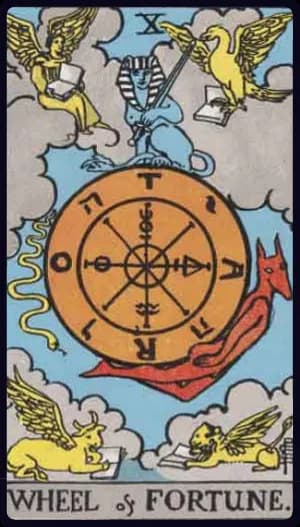
Wheel of Fortune Tarot Card Meaning: Luck, Cycles, and the Turn You Can't Stop
The Wheel of Fortune is card ten, and it's the first Major Arcana card with no person standing in the middle of it. The Magician has a...
1.8K40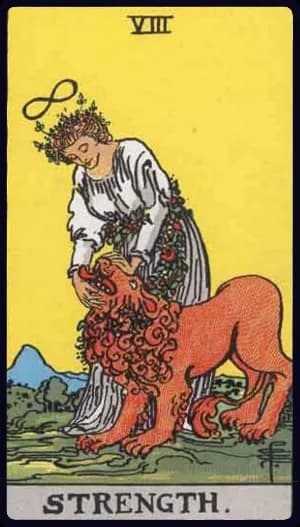
Strength Tarot Card Meaning: Courage, Patience, and the Gentle Kind of Power
Strength is card eight, and it shows one of the calmest scenes in the whole deck. A woman in a white dress has her hands on a lion's jaws,...
1175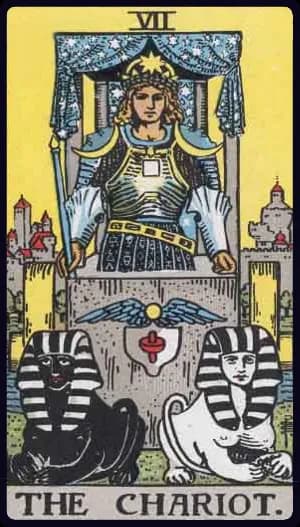
The Chariot Tarot Card Meaning: Willpower, Direction, and Winning the Hard Way
The Chariot is card seven, and it's the first card in the Major Arcana that's about winning. The cards before it are about learning who you...
40021