Wheel of Fortune Tarot Card Meaning: Luck, Cycles, and the Turn You Can't Stop
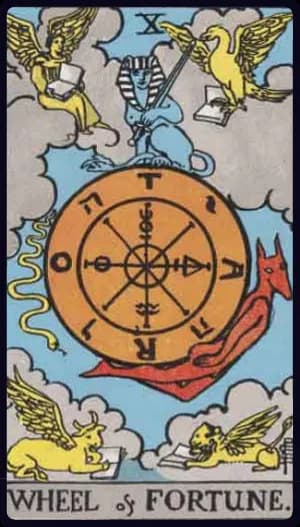
The Wheel of Fortune is card ten, and it's the first Major Arcana card with no person standing in the middle of it. The Magician has a table, the Emperor has a throne, the Hermit has a lantern and a mountain. The Wheel has a big turning circle floating in the sky, a few strange creatures riding it, and four winged figures watching from the clouds. Nobody is in charge. That's sort of the point.
Most of the cards before this one are about what you can do: learn a skill, build a structure, make a choice, master yourself, go inward. The Wheel is the card that reminds you some things just happen. Luck shows up. Luck leaves. Seasons change. The person who was on top last year is at the bottom this year, and the person at the bottom is climbing. You can't stop the Wheel, but you can decide how you ride it.
This guide covers where the card came from (the idea is much older than tarot), what every symbol on the Rider-Waite-Smith version means, the astrology behind it, how to read it upright and reversed in every area of life, how it changes by spread position, the cards that shift its meaning, and the mistakes people make with it.
Quick reference
| Number | 10 (X) |
| Arcana | Major |
| Element | Fire |
| Astrology | Jupiter |
| Hebrew letter | Kaph (כ) |
| Upright keywords | luck, cycles, change, fate, turning points, timing, momentum |
| Reversed keywords | bad luck, resisting change, stuck cycles, repeating patterns, delays |
| Yes or no | Yes (reversed: not right now) |
Where the Wheel of Fortune comes from
The Wheel was a famous image for a thousand years before anyone painted it on a tarot card. In the 6th century, the Roman philosopher Boethius wrote The Consolation of Philosophy while sitting in prison waiting to be executed. He'd gone from one of the most powerful men in Rome to a condemned man, and in the book Lady Philosophy explains to him that this is how Fortune works. Fortune turns her wheel. People rise and fall on it. Complaining that she turned it on you is like complaining that the weather changed.
That idea took off. Medieval churches, manuscripts, and stained glass windows were full of the Rota Fortunae, the wheel of Fortune, usually with a crowned goddess turning a crank and four little figures around the rim. They often came with Latin labels: regnabo (I will reign), regno (I reign), regnavi (I have reigned), and sum sine regno (I am without a kingdom). It was a warning to kings and a comfort to beggars. Nobody stays at the top, and nobody stays at the bottom.
Early Italian tarot decks used this image directly. The famous 15th-century Visconti-Sforza deck shows a blindfolded Fortune at the center of the wheel, with figures rising and falling around her and those same four Latin phrases. She's blindfolded because Fortune doesn't care who you are.
By the time of the Tarot de Marseille, Fortune herself had vanished from the card. La Roue de Fortune shows a wooden wheel on a stand with a crank handle and three odd animal figures: one climbing up, one tumbling down, and one perched on top wearing a crown and a cape and holding a sword. They look a bit like monkeys or dogs in clothes. The message is the same, just funnier: whoever's on top looks pretty silly, and they won't be up there for long.
What Waite and Smith changed
The Rider-Waite-Smith deck came out in 1909, with symbolism by Arthur Edward Waite and art by Pamela Colman Smith. Their Wheel looks very different from anything before it. It looks like a cosmic diagram: a glowing wheel in the sky covered in letters and alchemical symbols, with an Egyptian sphinx, a serpent, and a jackal-headed figure, and the four winged creatures from the Bible's Book of Ezekiel and Book of Revelation in the corners.
A lot of this came from Eliphas Lévi, the 19th-century French occultist whose writing shaped the whole Golden Dawn approach to tarot. Lévi had drawn a wheel with a sphinx on top, a figure rising on one side and a figure falling on the other, and Waite took that design and built on it.
In The Pictorial Key to the Tarot (1910), Waite's upright meanings are short and cheerful: destiny, fortune, success, elevation, luck, happiness. His reversed meanings are odd. He lists increase, abundance, and too much of a good thing. Modern readers mostly read the reversed Wheel as bad luck or stuck cycles instead, but Waite's version is worth remembering. Sometimes the problem with a lucky streak is that it's made you careless.
The symbolism, detail by detail
Smith's Wheel is one of the busiest cards in the deck. Here's what's on it.
The wheel itself. A big orange-gold circle with eight spokes, hanging in a blue sky. It isn't attached to anything. There's no crank and no hand turning it. In the older cards, Fortune turned the wheel, and in the Marseille deck you can at least see the handle. In Smith's version, it just turns. That shift matters. Change on this card is built into how things work, whatever anyone's mood.
The letters on the outer ring. Around the rim you can read T, A, R, O, spaced out at four points. Read clockwise from the top, it spells TARO (or TAROT, if you loop back to the T). Read other ways, it can spell ROTA (Latin for wheel), ORAT (speaks), TORA (law), and ATOR (an Egyptian goddess, Hathor). Waite was clearly having fun with this. The idea is that the wheel, tarot, and the law of the universe are all the same thing seen from different angles.
The Hebrew letters. Between the Latin letters are four Hebrew ones: Yod, Heh, Vav, Heh. That spells the four-letter name of God in the Hebrew Bible, often called the Tetragrammaton. So the wheel is also, quietly, a picture of the divine name turning through creation.
The alchemical symbols. On the inner ring are four symbols from alchemy: mercury at the top, sulfur and salt on either side, and the sign for water at the bottom. These were the basic ingredients alchemists believed everything was made from. Put together, they say the wheel is about the whole physical world and how it's always being mixed, dissolved, and remade.
The sphinx on top. A blue sphinx sits at the very top of the wheel, calm, holding a sword. She doesn't move when the wheel turns. She's often read as wisdom, or the part of you that stays steady while everything around you changes. The sword connects her to Justice, the next card: the truth that cuts through all the luck.
The snake on the left. A yellow serpent slides down the left side of the wheel. Waite calls it Typhon, a monster from Greek myth often linked to the Egyptian god Set, the force of chaos and destruction. It's the downward half of the cycle: the fall, the loss, the bad year.
The jackal-headed figure. Rising up the right side and underneath the wheel is a red figure with a jackal's head. Waite calls him Hermanubis, a blend of the Greek Hermes and the Egyptian Anubis, both guides of souls. He's the upward half of the cycle: recovery, growth, the climb back up. Notice that he's carried along by the wheel. He isn't climbing on his own.
The four winged creatures. In each corner, sitting on clouds, is a winged figure reading a book: an angel (top left), an eagle (top right), a lion (bottom right), and a bull (bottom left). These are the four living creatures from Ezekiel's vision and the Book of Revelation, later used as symbols of the four Gospel writers. Astrologers also link them to the four fixed signs of the zodiac: Aquarius (the angel), Scorpio (the eagle), Leo (the lion), and Taurus (the bull). They sit at the stable points of the year while the wheel spins in the middle. They're reading because they're learning, and they're calm because they've seen the wheel turn many times.
These same four creatures come back on the World, card 21. On the Wheel they're studying. On the World, the books are gone. That's a nice little hint that the lesson of the Wheel takes the whole journey to really learn.
The clouds and sky. Everything here happens up in the sky. The Wheel is about forces bigger than the everyday: timing, fate, the slow movement of years.
Astrology, element, and the Hebrew letter
The Golden Dawn gave the Wheel of Fortune the Hebrew letter Kaph (כ) and the planet Jupiter.
Kaph means the palm of the hand. That's a neat pairing with a card about fate, since palm reading is one of the oldest ways people have tried to read their future in the lines they were born with. A cupped palm is also the shape of receiving: an open hand that something can be dropped into.
Jupiter is the planet of luck, growth, expansion, and good fortune in traditional astrology. It's often called the "Great Benefic," the most generous of the planets. Jupiter takes about twelve years to go around the zodiac, so astrologers talk about "Jupiter returns" every twelve years as times of new growth. That gives the Wheel a sense of long, slow cycles on top of day-to-day luck.
Jupiter rules Sagittarius and, in traditional astrology, Pisces, so people with those signs prominent in their chart may feel close to this card. The Wheel is usually given the element Fire, through Jupiter's link with fiery, expansive Sagittarius.
The Jupiter link also explains why the upright Wheel leans lucky. In older thinking, the Wheel was neutral: up or down, equally likely. With Jupiter attached, the Golden Dawn tilted it toward fortune and opportunity.
Where the Wheel sits in the Fool's Journey
The Fool has just spent time with the Hermit, card nine, alone on a mountain with a lantern, figuring out who they are when nobody's watching. It's quiet up there, and it's easy to believe that with enough wisdom and self-knowledge, you can control your life.
Then the Fool comes down the mountain and meets the Wheel. Here's the lesson: you can know yourself perfectly and still get hit by things you didn't plan. Jobs get cut. People leave. Good luck falls in your lap for no reason. The world turns whether or not you're ready.
The Wheel sits right at the center of the Major Arcana, and a lot of readers treat it as the hinge of the whole journey. The first half of the trumps is mostly about the outside world and building a self. After the Wheel, the cards get stranger and harder: Justice, the Hanged Man, Death, the Devil, the Tower. The Fool has learned to stand up. Now they have to learn to stand up while the ground moves.
Right after the Wheel comes Justice, card eleven. If the Wheel says "things happen," Justice answers "and some of them happen because of what you did." Together they're a pair: chance and consequence, luck and cause.
The Wheel of Fortune upright
Keywords: luck, change, cycles, fate, turning points, good timing, opportunity, momentum, the big picture.
When the Wheel shows up upright, something is shifting, and usually in your favor. A door opens, a lucky break lands, things that were stuck start moving. Often it's a turning point you'll look back on later and say "that's when everything changed."
The upright Wheel has a strong sense of timing. It's the right moment. The pieces are lining up. If you've been waiting to act, the Wheel says the window is open now, and windows like this don't stay open forever.
It's also a card about cycles. You've been here before, maybe in a different form. A pattern is coming round again, or a season of your life is ending so another one can start. The upright Wheel asks you to notice the pattern. What did you learn last time this came around?
And it's a reminder that you're not fully in control, which can be a relief. If things have been hard, the Wheel says they won't stay that way. If you've been trying to force a result through sheer effort, the Wheel says some of this is out of your hands, so maybe ease up. Do your part, and then let the thing turn.
One more thing: upright, the Wheel is lucky, but it's still a wheel. What goes up comes around. Enjoy the good turn, and don't build your whole life on the assumption that it lasts forever. The sphinx on top is calm because she knows that.
The Wheel of Fortune reversed
Keywords: bad luck, setbacks, resisting change, repeating patterns, delays, feeling stuck, loss of control, broken cycles.
Reversed, the Wheel can mean a few different things, and it helps to sort out which one you're dealing with.
The wheel turned against you
The plain reading: a run of bad luck. Plans fall through, things go wrong for reasons that aren't your fault, the timing is off. This is the snake's side of the wheel, the downward turn.
It stings, but the reversed Wheel still carries the main message of the card: it turns. Bad seasons end. The question is what you do while you're at the bottom. Sometimes the best answer is to hold steady, take care of yourself, and wait for the climb.
Fighting the wheel
The more common reading in practice: the wheel wants to turn and you're holding on. A relationship has ended but you won't let it go. A job is clearly winding down but you're pretending it isn't. The world changed and you're still acting like it's three years ago.
Here the bad luck partly comes from the resistance itself. Trying to stop a wheel with your hands hurts. The reversed Wheel asks: what are you clinging to that's already moving away from you?
The same loop, again
The third reading: you're stuck in a cycle that keeps repeating. The same type of partner, the same money crisis every few months, the same argument, the same burnout. The wheel keeps turning, but it keeps landing you in the same place.
This one's actually hopeful, because it's the one you can do something about. A loop that repeats is a lesson you haven't finished. Once you spot the pattern, you can step off it.
Waite's "too much"
And there's Waite's old version: abundance, superfluity, too much. A lucky streak that's made you careless or greedy. Overspending because the money came easy. Overcommitting because everything's been going well. It's the point at the top of the wheel just before it tips.
How to tell which one it is
Ask yourself one question: is this happening to me, or am I part of why it keeps happening? If it truly came out of nowhere, it's the first reading, and your job is patience. If you feel a little caught out, it's probably the second or third, and your job is to let go or change the pattern.
The Wheel of Fortune in love and relationships
Upright
If you're single: a lucky meeting, a chance encounter, or someone coming back into your life at the right moment. The Wheel loves coincidences: the person you keep running into, the friend-of-a-friend at the party you almost skipped. Say yes to things. Your timing is good right now.
If you're in a relationship: the relationship is moving into a new phase. That could be a big step forward (moving in, engagement, a baby) or simply a shift in how you are together. It can also point to the relationship feeling "fated," like it was meant to happen. If things have been rocky, the Wheel suggests a turn for the better is coming.
For feelings ("how do they feel about me?"): they feel like meeting you was meant to be, or at least lucky. There's a sense of something significant. But the Wheel is also changeable, so their feelings may still be shifting and settling.
Reversed
If you're single: bad timing. The right person at the wrong moment, or near-misses that don't turn into anything. It can also point to a pattern: you keep dating the same kind of person with the same result. Take a look at the loop.
If you're in a relationship: a rough patch, things outside your control putting strain on you (money, family, distance, health), or a relationship resisting a change it needs to make. Sometimes it's an old fight that keeps coming back because nobody's dealt with what's under it.
For feelings: their feelings are up and down, or they feel like the situation is out of their hands. They may run hot and cold because they're unsettled themselves.
The Wheel of Fortune in career and work
Upright
A lucky break at work: a promotion, an unexpected job offer, a project that suddenly takes off, the right person seeing your work at the right time. The Wheel is great news for anyone waiting to hear back on something. It's also a good card for career changes, especially ones that feel like they "found you."
If you've been grinding without much to show for it, the Wheel says momentum is building. Keep going. And when the chance comes, take it, because timing is a big part of this card.
Reversed
Setbacks you didn't cause: layoffs, restructures, a market shift, a client pulling out. It can also mean you're in a career rut, doing the same thing in the same way and getting the same results. If you keep ending up in jobs that make you miserable for the same reasons, the reversed Wheel is pointing at the pattern.
The Wheel of Fortune in money and finances
Upright
Money luck: a windfall, a raise, a refund you forgot about, an investment that goes well. Things are turning in your favor. That said, Jupiter is generous but the wheel still turns. Use a good financial season to build a cushion for the next lean one.
Reversed
Unexpected expenses, a dip in income, or money trouble that comes from outside forces. It can also point to financial cycles you keep repeating: the feast-and-famine pattern, the same debt coming back. And in Waite's sense, it can warn against getting reckless because money came easy. Don't gamble on your lucky streak.
The Wheel of Fortune in health and wellbeing
Tarot isn't a substitute for medical advice. If you have health concerns, see a professional.
Upright
A turn for the better. If you've been unwell or worn down, the upright Wheel suggests improvement is coming. It's also a good card for paying attention to your body's cycles: sleep, energy, hormones, the seasons. Working with your rhythms helps.
Reversed
A setback, or health ups and downs that feel out of your control. It can also point to habits that keep repeating, like the crash-diet cycle or burning yourself out every few months. Look for the pattern and get proper support if you need it.
The Wheel of Fortune in spirituality
The Wheel is one of the big spiritual cards of the deck. It's about the idea that life moves in cycles, that everything rises and falls, and that the wise thing is to find the still center while the rim keeps spinning. Many traditions have some version of this: karma, the wheel of rebirth, the turning of the seasons, the idea that "this too shall pass."
Upright, it can mean a spiritual turning point, synchronicities piling up, or a sense that you're exactly where you're meant to be. Pay attention to coincidences right now.
Reversed, it can mean you're feeling spiritually stuck or abandoned by luck, or that you're trying so hard to control your life that you've lost touch with anything bigger. Sometimes the lesson is just to sit with the sphinx for a while and let things move.
The Wheel of Fortune by spread position
Past: a turning point that brought you here. A lucky break, a sudden change, or a moment you didn't choose but that set things in motion.
Present: you're in the middle of a shift. Things are moving. Pay attention to what's coming round and what's leaving.
Future: change is coming, most likely for the better. Something you can't fully predict will turn things around.
Advice: go with it. Stop fighting the change, look for the opportunity in it, and act while the timing is right. Also: notice the pattern you keep repeating.
Obstacle or challenge: you're resisting change, or you're stuck in a cycle you haven't recognized. Sometimes the obstacle is just bad timing, and the advice is patience.
Outcome: a turning point. The situation will shift, often in a way you didn't see coming. Upright, usually for the better.
Hopes and fears: you may hope for a lucky break and fear losing control at the same time. Most people want the good kind of change without the uncertainty that comes with it.
The Wheel of Fortune as a yes or no
The Wheel is usually a yes, and often a yes with good timing attached. Things are lining up in your favor. It's an especially strong yes for questions about change, opportunity, or whether something will turn around.
Reversed, it's closer to not right now. The timing is off, or something has to shift first. It's rarely a permanent no. The wheel keeps turning.
The Wheel of Fortune in combination with other cards
Wheel of Fortune + The Hermit: after a quiet season alone, life picks back up. The time for reflection is ending and things are about to move.
Wheel of Fortune + Justice: karma, in the everyday sense. What you put out is coming back. A cycle closing with a fair result.
Wheel of Fortune + The Tower: sudden, dramatic change. The wheel doesn't turn so much as lurch. Big upheaval that resets everything.
Wheel of Fortune + Death: the end of one chapter and the start of another. A cycle has finished for real and something new is beginning.
Wheel of Fortune + The Sun: a very lucky turn. Success, happiness, things going your way. One of the best pairings in the deck.
Wheel of Fortune + The World: a full cycle completing. You've come all the way around and you're ready for the next round.
Wheel of Fortune + The Lovers: a fated-feeling relationship, or a meeting that changes the direction of your life.
Wheel of Fortune + Ten of Pentacles: long-term luck with money or family. Inheritance, generational patterns, or a turn of fortune that affects the whole household.
Wheel of Fortune + Six of Pentacles: money coming in, often through someone else's generosity. Gifts, help, or a lucky exchange. Remember the wheel turns, and pass it on when you can.
Wheel of Fortune + Four of Pentacles: clinging to what you have because you're scared the luck will run out. Holding on so tight that nothing new can come in.
Wheel of Fortune + Eight of Wands: fast change. Things move quickly once the wheel starts turning. News, travel, or developments arriving all at once.
Wheel of Fortune + Five of Pentacles: a hard financial or emotional season. But the Wheel says it's a season, and seasons end.
Common mistakes when reading the Wheel of Fortune
Reading it as pure luck with no part for you. The Wheel turns on its own, but you still choose what to do when it lands. A lucky break you don't act on is just a story about something that almost happened.
Treating it as a guarantee. The upright Wheel is good news, and wheels keep turning. Use the high point well.
Panicking when it's reversed. The reversed Wheel is not a curse. Bad luck turns too. And often the reversed card is pointing at something you can change: a pattern, or a grip that needs loosening.
Ignoring the cycle part. People get so focused on "luck" that they forget the Wheel is also about repetition. If it keeps showing up, ask what keeps coming round in your life.
Assuming fate means you have no choice. The Wheel describes the forces you can't control. It doesn't say you have no control at all. The next card is Justice, which is all about choice and consequence. The two work together.
The Wheel of Fortune as a person
When the Wheel represents a person, it's often someone who arrives at a turning point in your life and changes its direction. The stranger who offers you the job, the person you meet by chance who becomes important, the friend who shows up at exactly the right time.
As a personality, it can describe someone whose life seems to go up and down dramatically, a person with famously good or bad luck, or someone very adaptable who rolls with every change. At their best, they're optimistic, flexible, and great in a crisis. At their worst, they're unreliable and always waiting for luck to fix things while the work sits there undone.
Journal prompts for the Wheel of Fortune
- What pattern keeps coming round in my life? When did I first notice it?
- What am I trying to control that's actually out of my hands?
- Where am I holding on to something that's already turning away?
- Think of a lucky break from the past. What did I do to make the most of it, or what did I miss?
- If this hard season is temporary, how do I want to spend it?
- What's the "sphinx" in my life, the steady thing that stays put while everything else spins?
Frequently asked questions
Is the Wheel of Fortune a good or bad card? Mostly good. Upright, it means luck, positive change, and good timing. Reversed, it can mean setbacks or stuck patterns, but even then it reminds you that things will turn.
Does the Wheel of Fortune mean fate? Partly. It's about the forces outside your control, including timing, chance, and the cycles of life. You still get a say in how you respond to what fate hands you.
What does the Wheel of Fortune mean as feelings? Upright, a sense that the connection is meant to be, or excitement about how things are changing. Reversed, mixed or unstable feelings, or a sense that things are out of their control.
What zodiac sign is the Wheel of Fortune? The Wheel is linked to the planet Jupiter. Jupiter rules Sagittarius and, traditionally, Pisces, so those signs are the ones most connected to it.
Does the Wheel of Fortune mean karma? It can. Many readers link it to karma in the loose sense of "what goes around comes around," especially when it shows up near Justice. But the Wheel itself is more about cycles and chance than about deserving.
What does it mean if the Wheel keeps showing up? You're in a period of change, or something in your life is repeating. If it's upright, watch for opportunities. If it's reversed, look at the patterns you keep landing in.
Where the journey goes next
The Fool came down from the Hermit's mountain and found out that wisdom doesn't stop the wheel from turning. If you missed it, you can read yesterday's Hermit guide to see what the Fool learned up there.
Next up is Justice, card eleven, where the Fool learns that some of what comes round is the result of what you did. That's tomorrow's card.
Until then, you can see the Wheel's upright and reversed meanings and how it shows up in readings on the Wheel of Fortune card page. Or draw a card in Taroter and see which way the wheel turns for you today.
Ara Mckee
Writer
Related articles
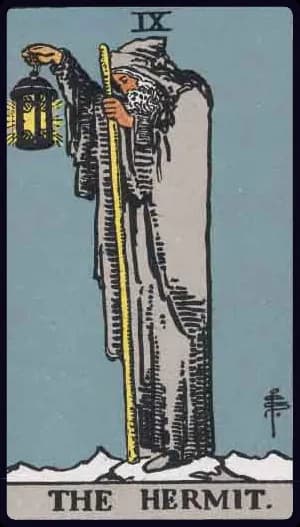
The Hermit Tarot Card Meaning: Solitude, Soul-Searching, and the Light You Carry
The Hermit tarot card meaning starts with silence. It's card nine, the quietest card in the Major Arcana. An old man in a gray cloak stands...
1.9K55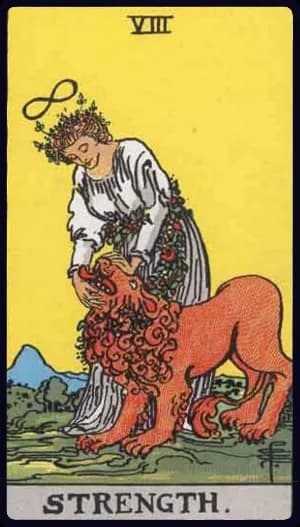
Strength Tarot Card Meaning: Courage, Patience, and the Gentle Kind of Power
Strength is card eight, and it shows one of the calmest scenes in the whole deck. A woman in a white dress has her hands on a lion's jaws,...
1175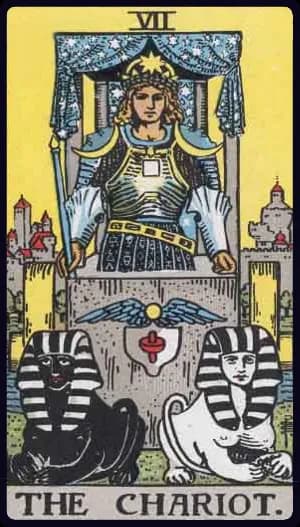
The Chariot Tarot Card Meaning: Willpower, Direction, and Winning the Hard Way
The Chariot is card seven, and it's the first card in the Major Arcana that's about winning. The cards before it are about learning who you...
40021