The Hanged Man Tarot Card Meaning: Surrender, Pause, and Seeing It Upside Down
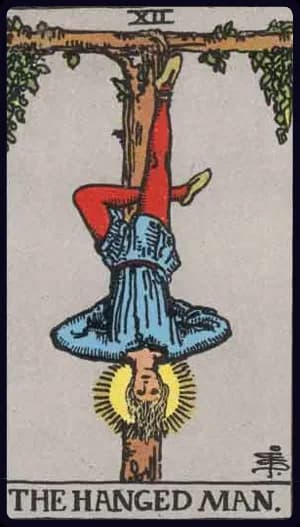
The Hanged Man is card twelve, and he has the scariest name in the deck after Death. A man hanging from a tree sounds like a horror movie. But look at the actual card. He's hanging by one foot, upside down, with his hands behind his back and a glowing halo around his head. His face is calm. He doesn't look like he's suffering. He looks like he's thinking, or maybe like he's just figured something out.
That's the Hanged Man in a nutshell. It's the card of the pause: the moment when you stop pushing, stop trying to fix it, and let yourself be suspended for a while. Things look different upside down. Sometimes the only way to see a problem clearly is to stop wrestling with it.
This guide covers where the card came from (its origins are darker than its modern meaning), what each detail on the Rider-Waite-Smith card means, the astrology and Hebrew letter behind it, how to read it upright and reversed in every area of life, how it changes by spread position, the cards that shift its meaning, and the mistakes people make with it.
Quick reference
| Number | 12 (XII) |
| Arcana | Major |
| Element | Water |
| Astrology | Neptune (modern); Water (Golden Dawn) |
| Hebrew letter | Mem (מ) |
| Upright keywords | surrender, pause, new perspective, letting go, waiting, sacrifice, suspension |
| Reversed keywords | stalling, resistance, pointless sacrifice, martyrdom, indecision, feeling stuck |
| Yes or no | Not yet (reversed: no, or stop waiting) |
Where the Hanged Man comes from
The Hanged Man had a very different job in Renaissance Italy. In some of the earliest tarot decks he was called Il Traditore: the traitor.
That name points to a real custom. In 15th-century Italian cities like Florence and Milan, people who'd committed serious crimes, especially traitors, debtors who fled, and rebels, were sometimes punished with what were called pitture infamanti, "shaming paintings." The city would paint a picture of the guilty person on a public wall, often hanging upside down by one foot. It was humiliation in public, for everyone to see. Being hung upside down was the posture of disgrace, of someone whose world had literally been turned over because they'd betrayed it.
Some early tarot versions push the point further: the hanging man holds or drops bags of money, which links him to Judas and his thirty pieces of silver. So for the first players of the game, this card was about betrayal and shame.
In the Tarot de Marseille, he's Le Pendu, the hanged one. He hangs by one foot from a beam stretched between two trees with their branches cut off, his hands behind his back and one leg bent. His expression is often oddly mild for someone in that position. Even in the old decks, there's something about him that doesn't quite read as punishment.
What Waite and Smith changed
When Arthur Edward Waite and Pamela Colman Smith made the Rider-Waite-Smith deck in 1909, they leaned hard into that calm. Smith's Hanged Man hangs from a tree that's alive, with leaves on it. His face is peaceful. And around his head is a bright halo, the kind you'd normally see on a saint.
In The Pictorial Key to the Tarot (1910), Waite is clear that he doesn't see this as a card about martyrdom or execution. He describes the face as one of deep trance rather than pain, and says the card is really about the relationship between the divine and the world, and about a kind of spiritual awakening for anyone who understands it. He's typically vague about the details, but the direction is obvious: this is a man who's chosen to be where he is, and he's seeing something the rest of us can't.
Waite's list of upright meanings is all over the place in a useful way: wisdom, caution, discernment, trials, sacrifice, intuition, divination, and prophecy. His reversed meanings are short and a bit strange: selfishness, the crowd, and "the body politic." Modern readers mostly read the reversed card as stalling or pointless sacrifice, but Waite's version has a point too. Upright, the Hanged Man steps out of the crowd and sees differently. Reversed, he goes back to thinking like everybody else.
The Odin connection
Many modern readers also link the Hanged Man to the Norse god Odin, who in the old poems hung himself on the world tree Yggdrasil for nine nights, wounded and without food or water, in order to gain the knowledge of the runes. There's no evidence the original tarot designers had Odin in mind. But the parallel is a good one: a willing sacrifice, hanging from a living tree, that ends in wisdom. That's basically the modern reading of the card.
The symbolism, detail by detail
Upside down. The obvious one. The Hanged Man sees the world from the opposite angle to everyone else. Everything that seemed up is down. What seemed important looks small, and what seemed small might turn out to be the whole point.
Hanging by one foot. He's tied by his right foot only. The rope is around his ankle, and there's nothing else holding him. He could probably wriggle loose if he wanted. That's an important detail. He's not trapped so much as committed. He's chosen to stay.
The bent leg. His left leg is bent behind his right knee, making a shape like a number 4 or a cross. Some readers link this to the Emperor, card four, who often sits with his legs crossed in a similar way: the Emperor's stable, worldly order turned completely upside down. Others see a cross, a symbol of sacrifice.
Hands behind his back. His arms are folded behind him, out of sight. He isn't doing anything. He isn't reaching for anything or holding on. For a card about surrender, that's the key: the hands that usually grab and fix and control are put away.
The halo. A bright golden glow surrounds his head. This is Smith's biggest change from the old shaming image. The halo says insight, enlightenment, the light bulb moment. Something has clicked. The pause produced understanding.
The calm face. He looks peaceful, maybe even content. No panic, no pain. That's the emotional heart of the card: you can be in a strange, uncomfortable position and still be at peace with it.
The living tree. The beam he hangs from is shaped like a T, a Tau cross, and it's made of living wood with green leaves sprouting from it. In the older decks, the trees had their branches cut off. Here, the wood is alive. The suspension is part of growth, not death.
The colors of his clothes. He wears a blue tunic and red tights, with yellow shoes. Blue is often read as calm, intuition, and the spiritual. Red is passion, the body, and the physical world. Upside down, the red is up and the blue is down, which some readers see as the usual order of things reversed: the body raised up toward heaven, the spirit nearer the ground.
The plain background. There's no landscape, no sky, no other figures. Just him and the tree in a flat grey space. The Hanged Man is outside of ordinary time and place. Nothing is happening around him, and that's the point.
Astrology, element, and the Hebrew letter
The Golden Dawn gave the Hanged Man the Hebrew letter Mem (מ) and the element Water.
Mem is one of three special letters in Hebrew mysticism called the "mother letters": Aleph, Mem, and Shin. The Golden Dawn linked these to the three elements of Air, Water, and Fire, and gave them to three Major Arcana cards: the Fool (Aleph, Air), the Hanged Man (Mem, Water), and Judgement (Shin, Fire). So the Hanged Man is one of only three trumps tied directly to a pure element rather than a sign or planet. That puts him in very old company.
Mem means water, which fits beautifully. Water doesn't fight. It finds its level, it surrenders to gravity, and it takes the shape of whatever holds it. It's also the element of feeling, intuition, and the unconscious. Think of being underwater: sound goes quiet, time slows, you float. That's a decent description of what the Hanged Man feels like from the inside.
Later astrologers linked the card to Neptune, the planet of dreams, mysticism, surrender, and dissolving boundaries. Neptune was discovered in 1846, long after the tarot existed, so the link is modern. But Neptune rules Pisces, the most surrender-friendly sign in the zodiac, and the pairing feels right. Neptune is also the planet of confusion and fog, which is a good reminder that the Hanged Man's suspended state can tip into just being lost if it goes on too long.
If you're a Pisces, or you have a lot of Water or Neptune in your chart, you may find the Hanged Man shows up for you more than most.
Where the Hanged Man sits in the Fool's Journey
The Fool has just stood in front of Justice, card eleven, and learned about cause and effect: weigh things fairly, own your choices, and the results follow. It's a very sensible, grown-up lesson. You do the right thing, and the right thing happens.
Then the Fool meets the Hanged Man and finds out that sometimes doing the right thing means doing nothing at all. Some problems can't be solved by effort, logic, or a clear decision. They have to be waited out, or seen differently, or let go of entirely. The Fool, who has spent the whole journey so far learning how to act, has to learn how to stop.
It's a big shift. Up to now, most of the Fool's lessons have been about gaining things: skill, intuition, structure, love, willpower, strength, wisdom, luck, fairness. The Hanged Man is the first card where the lesson is about giving something up. That makes it a kind of doorway into the second, harder half of the Major Arcana.
And right after it comes Death, card thirteen. The Hanged Man is the pause before the big ending. He hangs in between, letting go of the old way of seeing, so that when Death comes to clear out what's finished, he's ready.
The Hanged Man upright
Keywords: surrender, pause, waiting, new perspective, letting go, sacrifice, patience, insight, suspension, a different angle.
When the Hanged Man shows up upright, things are on hold. Something is paused, delayed, or in limbo, and pushing harder won't fix it. The card asks you to stop struggling and let yourself hang there for a bit.
That's hard. Most of us hate waiting. We want to make the call, send the email, push for an answer. The Hanged Man says the answer will come, but not from pushing. Pause. Step back. Let the situation be what it is for now.
The upright card is also about seeing it differently. If you've been stuck on a problem, you've probably been looking at it the same way over and over. The Hanged Man asks you to turn it upside down. What if the thing you think is the problem isn't? What if the obstacle is actually the answer? What would someone who disagrees with you say? Sometimes the breakthrough comes from the most unexpected angle.
It's a card of sacrifice, but usually the willing, useful kind. Giving something up in the short term so that something better can happen. Skipping the party to finish the project. Letting go of being right so a relationship can heal. Giving up control so someone else can grow. The Hanged Man asks: what are you willing to let go of?
And it's a card of surrender, in the healthiest sense. That doesn't mean giving up or losing. It means accepting what you can't change and trusting the process. Interestingly, that acceptance is often exactly what gets things moving again.
The Hanged Man reversed
Keywords: stalling, resistance, indecision, pointless sacrifice, martyrdom, feeling stuck, delay, refusing to let go.
Reversed, the Hanged Man can go two quite different ways.
Hanging too long
The pause has gone on past the point where it's useful. You've been "waiting for the right time" for months. You've been stuck in limbo so long it's become comfortable, or at least familiar. The suspension that was meant to bring insight has turned into stalling.
This is the Neptune fog side of the card. You might be avoiding a decision by telling yourself you're "letting it unfold." The reversed Hanged Man says: you've seen what you needed to see. Time to come down from the tree and do something with it.
This side also includes martyrdom: sacrifice that doesn't actually achieve anything. Giving and giving to people who don't appreciate it. Staying in a bad situation because you think suffering is noble. Waiting for someone to notice how much you're putting up with. The upright Hanged Man gives something up for a reason. The reversed one gives things up and resents it.
Refusing to hang at all
The opposite. The situation clearly needs a pause, and you won't take one. You keep pushing, forcing, fighting, and getting nowhere. Every time you try a new tactic, it's really the same old tactic. You won't let go of control, and you won't consider that you might be looking at it wrong.
This version of the reversed card often shows up for people who are exhausted from struggling. The message is simple: put it down for a minute. You don't have to solve this today.
How to tell which one it is
Ask yourself: am I waiting, or am I hiding? And then: am I fighting, or am I avoiding being still? If you've been in limbo for ages, it's probably the first. If you've been pushing so hard you haven't stopped to breathe, it's the second. Either way, the reversed Hanged Man is about the wrong relationship with pausing: too much of it, or none at all.
The Hanged Man in love and relationships
Upright
If you're single: this might be a time to pause dating, or at least to stop chasing. Take a break and look at what you actually want. The Hanged Man can also mean a new way of seeing love: maybe the kind of person you need isn't the kind you've been looking for. If someone's on your mind, give it time. Don't force it.
If you're in a relationship: the relationship is in a holding pattern, or something needs to be seen from the other person's angle. If you're stuck in a disagreement, try genuinely standing in your partner's shoes. It can also point to a sacrifice one of you is making for the relationship, like a move or a career change. Make sure it's chosen and appreciated, not resented.
For feelings ("how do they feel about me?"): they're uncertain or in limbo. They may have feelings but aren't ready to act on them yet, or they're seeing you in a new light. Give it time.
Reversed
If you're single: you might be waiting around for someone who isn't coming, or putting your whole life on hold for a person who hasn't committed. Or you're forcing connections that aren't there.
If you're in a relationship: stuck in limbo for too long, or one person is sacrificing far more than the other and it's turning into resentment. It can also point to a relationship where nobody will let go of being right.
For feelings: they may feel stuck, unsure, or like they're giving more than they're getting. Or they're stalling on a decision about you.
The Hanged Man in career and work
Upright
A pause in your career: waiting to hear back, a project on hold, a sabbatical, a hiring freeze. Frustrating, but the Hanged Man suggests it's useful. Use the time to rethink your direction. Something you've been taking for granted about your work might look very different from a new angle.
It can also point to a sacrifice for your career, like taking a pay cut for a role that's a better long-term fit, or going back to study. Or, more simply, to the creative breakthrough that comes when you stop trying so hard and let your mind wander.
Reversed
You've been stuck in a job or a plan for too long, waiting for things to change on their own. Or you're making sacrifices at work that nobody notices and that aren't getting you anywhere. It can also mean pushing hard on a project that really needs a step back and a rethink.
The Hanged Man in money and finances
Upright
A time to hold off. Don't rush into big purchases or investments. Wait and see. It can also point to a short-term sacrifice, like cutting back now to save for something that matters. Look at your finances from a different angle. Is there an assumption about money you could turn upside down?
Reversed
Financial limbo that's gone on too long, or waiting for money problems to sort themselves out. It can also point to giving away too much money (lending to people who never pay back, overspending on others) in a way that hurts you.
The Hanged Man in health and wellbeing
Tarot isn't a substitute for medical advice. If you have health concerns, see a professional.
Upright
Rest. The Hanged Man is a strong signal to slow down, recover, and let your body do its thing. It's a good card for gentle practices like stretching, yoga (yes, including inversions, if your body likes them), meditation, and just lying down for a bit. It can also point to waiting for results or a recovery that takes its own time.
Reversed
Ignoring the need to rest, or pushing through when your body is asking you to stop. It can also mean a recovery that's stalled, or feeling stuck in a health situation. If something's not improving, get it checked.
The Hanged Man in spirituality
The Hanged Man is one of the most spiritual cards in the tarot. It's about surrender in the religious and mystical sense: letting go of the ego's need to control everything, and opening up to something larger. Meditation, prayer, fasting, retreats, and long quiet walks all have a bit of Hanged Man energy to them.
Upright, it can mean a spiritual breakthrough that comes from stillness, an insight you couldn't have reached by thinking harder, or a willingness to give up an old belief so a truer one can take its place. The halo is the sign: something has lit up.
Reversed, it can mean spiritual bypassing (using "surrender" as an excuse to avoid real problems), or a spiritual practice that's become a way to hide from life instead of engage with it. It can also point to the restless feeling of wanting enlightenment right now, without the waiting.
The Hanged Man by spread position
Past: a time of waiting, sacrifice, or seeing things differently. A pause that changed the way you look at your life.
Present: you're in limbo right now. Things are on hold. This is a time to reflect, not to force.
Future: a pause is coming. Something will slow down or be delayed, and that delay will bring a new perspective.
Advice: stop pushing. Let it be for a while. Try looking at the situation from a completely different angle, or from someone else's point of view.
Obstacle or challenge: you're stuck because you won't let go, or you've been waiting so long that the waiting itself has become the problem.
Outcome: the situation won't resolve the way you expect. Instead, you'll come away seeing it, and maybe yourself, differently.
Hopes and fears: you may want a break from the struggle and fear what happens if you stop trying. Letting go can feel like losing, even when it's the right thing to do.
The Hanged Man as a yes or no
The Hanged Man is a not yet, or a maybe. Things are on hold. The answer isn't ready, and pushing for it won't help. Wait, reflect, and ask again later.
Reversed, it leans toward no, or stop waiting for this. If you've been hanging on for an answer for a long time, the reversed Hanged Man suggests it may be time to move on.
The Hanged Man in combination with other cards
The Hanged Man + Justice: don't rush the verdict. A decision is coming, but it needs more time and a fresh angle first.
The Hanged Man + Death: surrender leading to a real ending. Letting go of something so completely that a new chapter can start.
The Hanged Man + The Wheel of Fortune: waiting for the timing to change. Things are on hold now, but the wheel will turn.
The Hanged Man + The High Priestess: deep intuition through stillness. The answer will come from inside, not from outside, if you're quiet enough to hear it.
The Hanged Man + The Tower: a sudden shock that turns your world upside down and forces a new perspective whether you're ready or not.
The Hanged Man + The Star: healing through rest and surrender. After a hard time, letting go brings hope back.
The Hanged Man + Four of Swords: a strong call for rest and recovery. Step away completely for a while.
The Hanged Man + Two of Swords: stuck in indecision. Both cards suggest you're avoiding a choice. The pair asks whether you're waiting for clarity or hiding from it.
The Hanged Man + Eight of Swords: feeling trapped, but the trap may be your own way of looking at things. Change the angle and the bonds loosen.
The Hanged Man + Seven of Cups: too many options and no decision. Daydreaming instead of choosing. Time to come down from the tree.
The Hanged Man + Knight of Wands: impatience against the need to wait. Someone wants to charge ahead when the situation needs a pause.
The Hanged Man + Ten of Wands: carrying too much and refusing to put it down. The Hanged Man says: let some of it go.
Common mistakes when reading the Hanged Man
Reading it as death or doom. The name sounds grim, but the card isn't about literal hanging or harm. It's about pausing and seeing differently.
Reading it as giving up. Surrender in the Hanged Man's sense is active. He chose to be there. It's letting go of control, not letting go of yourself.
Assuming it means "never." The Hanged Man is about delay, not denial. Things are on hold, not cancelled.
Ignoring the reversed warning about martyrdom. It's easy to feel noble about how much you're sacrificing. Make sure the sacrifice is actually doing something, and that you're not just quietly suffering and hoping someone notices.
Using it as an excuse to never decide. "The Hanged Man says wait" can become a very comfortable hiding place. The pause is supposed to produce insight. Once you've got it, act on it.
The Hanged Man as a person
When the Hanged Man represents someone, it's often a person who thinks differently from everyone else. They see the world from an unusual angle, march to their own beat, and often notice what everyone else missed. They can be spiritual, intuitive, artistic, or a bit of a dreamer. They're very good at patience and very bad at being rushed.
At their best, they're wise, open-minded, and willing to give things up for what they believe in. At their worst, they can be indecisive, passive, or stuck in a pattern of self-sacrifice that wears them down. Reversed, it might be someone who's always "about to" make a change but never does, or someone who plays the martyr.
Journal prompts for the Hanged Man
- What am I trying to force that might go better if I stopped pushing?
- If I looked at my biggest problem upside down, what would I see?
- What am I willing to give up for something that matters more?
- Where am I waiting, and is it patience or avoidance?
- Is there a sacrifice I'm making that nobody asked for? What would happen if I stopped?
- When was the last time I let myself do nothing at all? What came up?
Frequently asked questions
Is the Hanged Man a good or bad card? Neither, really. It's a card of pause and perspective. It can be frustrating, because it often means waiting, but it usually leads to an important insight.
Does the Hanged Man mean death? No. Despite the name, the Hanged Man isn't about physical death or harm. It's about suspension, surrender, and seeing things differently. The card that comes next, Death, is also usually about endings and change rather than literal death.
What does the Hanged Man mean as feelings? Uncertainty, limbo, or seeing you in a new way. They may have feelings but aren't ready to act on them, or they're reconsidering the situation.
What zodiac sign is the Hanged Man? The Hanged Man is linked to the element Water and, in modern astrology, the planet Neptune. Pisces, ruled by Neptune, is the sign most often connected to it.
How long does the Hanged Man's waiting last? Tarot isn't great at exact timing, but the Hanged Man is a "this will take as long as it takes" card. The waiting usually ends once you've stopped fighting it and seen what you needed to see.
What does it mean if the Hanged Man keeps showing up? Something in your life is asking you to stop, let go, or look at it differently. If it keeps coming up reversed, ask whether you've been waiting too long or pushing too hard.
Where the journey goes next
After Justice showed the Fool how cause and effect works, the Hanged Man showed them that some answers only come when you stop trying to make them happen. If you missed it, you can read yesterday's Justice guide to see what the Fool learned about fairness and owning your choices.
Next up is Death, card thirteen, where the Fool finally lets go of what's finished so something new can grow in its place. That's tomorrow's card.
Until then, you can see the Hanged Man's upright and reversed meanings and how it shows up in readings on the Hanged Man card page. Or draw a card in Taroter and see what looks different upside down.
Ara Mckee
Writer
Related articles
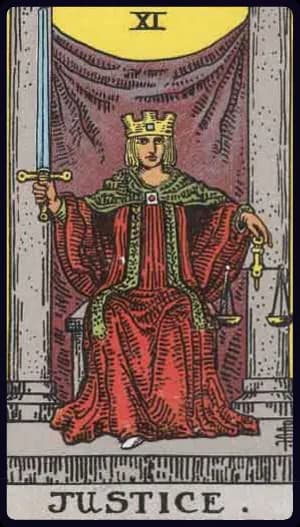
Justice Tarot Card Meaning: Truth, Fairness, and the Bill That Always Comes Due
Justice is card eleven, and she's one of the most straightforward figures in the deck. She sits on a throne, looks you dead in the eye, and...
25211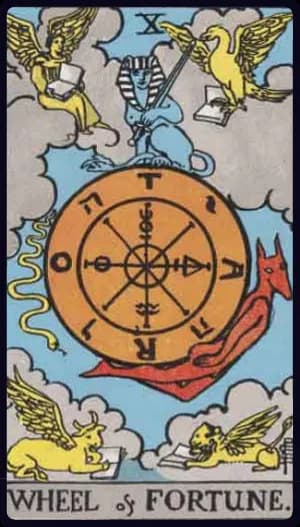
Wheel of Fortune Tarot Card Meaning: Luck, Cycles, and the Turn You Can't Stop
The Wheel of Fortune is card ten, and it's the first Major Arcana card with no person standing in the middle of it. The Magician has a...
1.8K40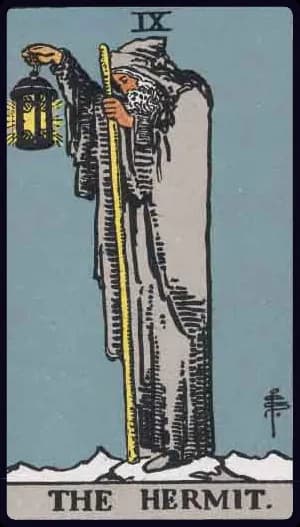
The Hermit Tarot Card Meaning: Solitude, Soul-Searching, and the Light You Carry
The Hermit tarot card meaning starts with silence. It's card nine, the quietest card in the Major Arcana. An old man in a gray cloak stands...
1.9K55